Lab scale Bioreactor for Cultured Meat Production and Research
Cultured meat is produced by growing animal cells in a controlled bioreactor environment. This technology is becoming increasingly important as a sustainable alternative to conventional meat production, helping reduce environmental impact, antibiotic use, and dependence on livestock farming. Developing cultured meat requires reliable bioreactor systems capable of maintaining precise and stable cultivation conditions to support cell growth and differentiation.
A lab-scale bioreactor is essential for cultured meat research, process development, and optimization. It allows researchers to accurately control critical parameters such as oxygen supply, nutrient distribution, temperature, and mixing conditions. Proper control of these factors is necessary to ensure high cell viability, reproducible results, and efficient cultured meat production.

Challenges with Conventional Bioreactors for Cultured Meat
Several types of bioreactors for cell culture and cultured meat research are currently used. However, conventional systems often present limitations, particularly when working with sensitive mammalian cells and stem cells.
Stirred Tank Bioreactors
Stirred tank bioreactors are widely used due to their scalability and process control. However, the rotating impellers generate high shear stress, which can damage delicate cells and reduce viability. Foam formation and vortex effects can negatively influence culture stability. In addition, when microcarriers are used, cell harvesting may become difficult.
Airlift Bioreactors
Airlift bioreactors use gas flow to mix the culture medium, reducing mechanical stress. However, mixing efficiency decreases at higher cell densities, leading to uneven oxygen and nutrient distribution. Maintaining consistent conditions during scale-up can also be challenging.
Rocking Motion Bioreactors
Rocking motion bioreactors provide gentle mixing but have limitations in scalability and efficiency. Mixing and oxygen transfer decrease at larger volumes, and disposable bags increase operating costs.
LAMBDA Minifor2Bio touch – Advanced Bioreactor for Cultured Meat Research
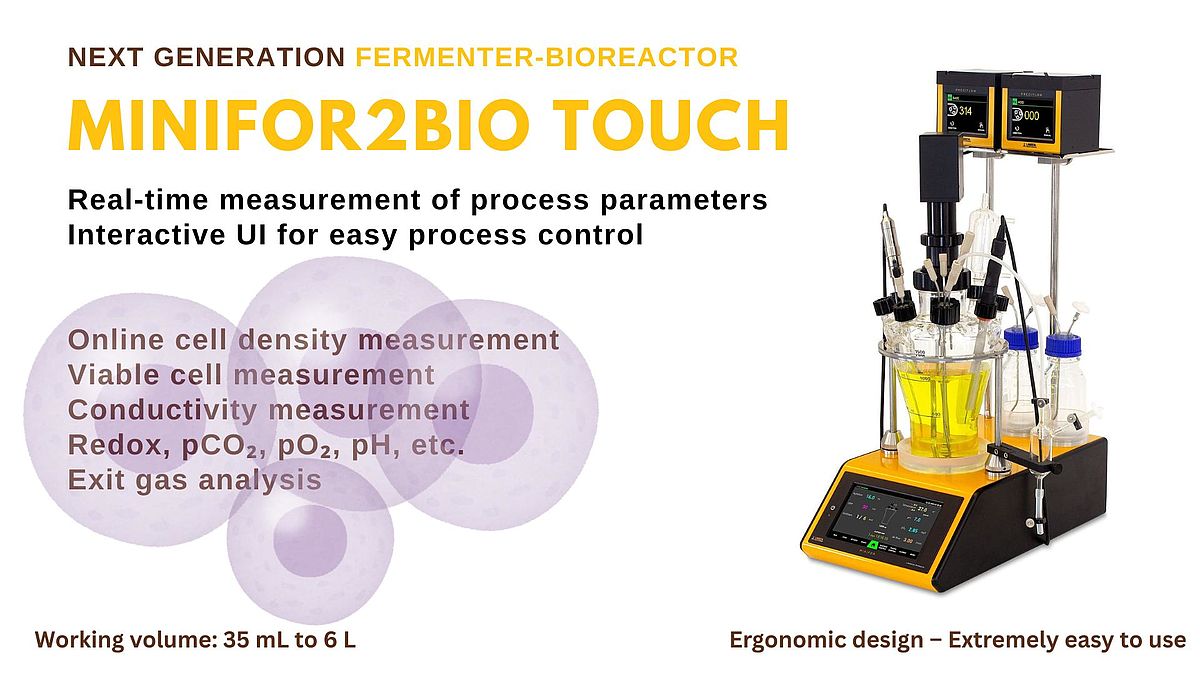
The LAMBDA Minifor lab-scale bioreactor is specifically designed to meet the requirements of advanced cell culture applications. It provides precise environmental control and an innovative gentle mixing system that protects sensitive cells while ensuring efficient oxygen transfer and nutrient distribution.

LAMBDA Minifor2Bio touch bioreactor with working volume from 35ml
Advanced Automatic Gas Mixing for Cell Culture with Massflow Regulators
The Minifor2Bio touch bioreactor system delivers precise and reliable gas mixing and control for cell culture applications, enabling accurate regulation of Air, O₂, CO₂, and N₂ through dedicated flow channels with integrated MASSFLOW gas flow controllers.
Designed for demanding mammalian cell culture, stem cell culture, and controlled bioprocess environments, the system supports:
• 4-Gas Mixing System – ideal for mammalian and stem cell cultures requiring stable and continuous gas composition
• 3-Gas Mixing Configuration – optimized for anaerobic fermentation and CO₂-based pH control
• 2-Gas Mixing Setup – precise oxygen enrichment and dissolved oxygen (pO₂) regulation
The fully automated gas mixing and real-time monitoring system ensures consistent oxygen and carbon dioxide control, promoting efficient gas transfer via sparging or surface aeration while maintaining low-shear, cell-friendly agitation conditions.
CO₂ Cascade Function for Automatic pH Regulation
The system includes an advanced CO₂ cascade control function, allowing automatic adjustment of CO₂ flow in response to pH measurements. This enables:
-
Stable and precise pH control in cell culture media
-
Reduced base consumption
-
Gentle, non-invasive pH regulation without excessive chemical addition
-
Improved process stability in long-term cell cultivation
The fully automated gas mixing and real-time monitoring system ensures consistent oxygen transfer, carbon dioxide regulation, and optimal gas diffusion via sparging or surface aeration while maintaining low-shear, cell-friendly agitation conditions.
Gentle Mixing Technology for Sensitive Cell Cultures
Unlike conventional systems that use rotating impellers, the LAMBDA Minifor bioreactor uses a non-rotational up-and-down agitation system with biomimicking fish-tail agitation discs made of soft, flexible silicone.
This advanced mixing technology provides:
Very low shear stress, protecting sensitive cells
Gentle mixing ideal for mammalian and stem cells
Improved cell viability and growth performance
Uniform oxygen and nutrient distribution
Reduced foam formation and stable culture conditions
The flexible silicone agitation discs gently move the culture medium without damaging cells, making the system an ideal bioreactor for cultured meat production.
Stable Culture Conditions and Reliable Process Control
The LAMBDA Minifor bioreactor provides precise control of temperature, aeration, and mixing, ensuring stable and reproducible cultivation conditions. The integrated infrared heating system delivers uniform temperature control, protecting sensitive cells and supporting optimal growth.
The shaft-free agitation system reduces contamination risk, improves sterility, and minimizes maintenance requirements.
Reduce Media Costs with Flexible Working Volume from 35 mL to 6 L
The LAMBDA Minifor lab-scale bioreactor offers a wide working volume range from 35 mL to 6 liters, making it highly suitable for cultured meat research and process optimization. Researchers can perform experiments at small working volumes, significantly reducing the use of expensive culture media and growth factors.
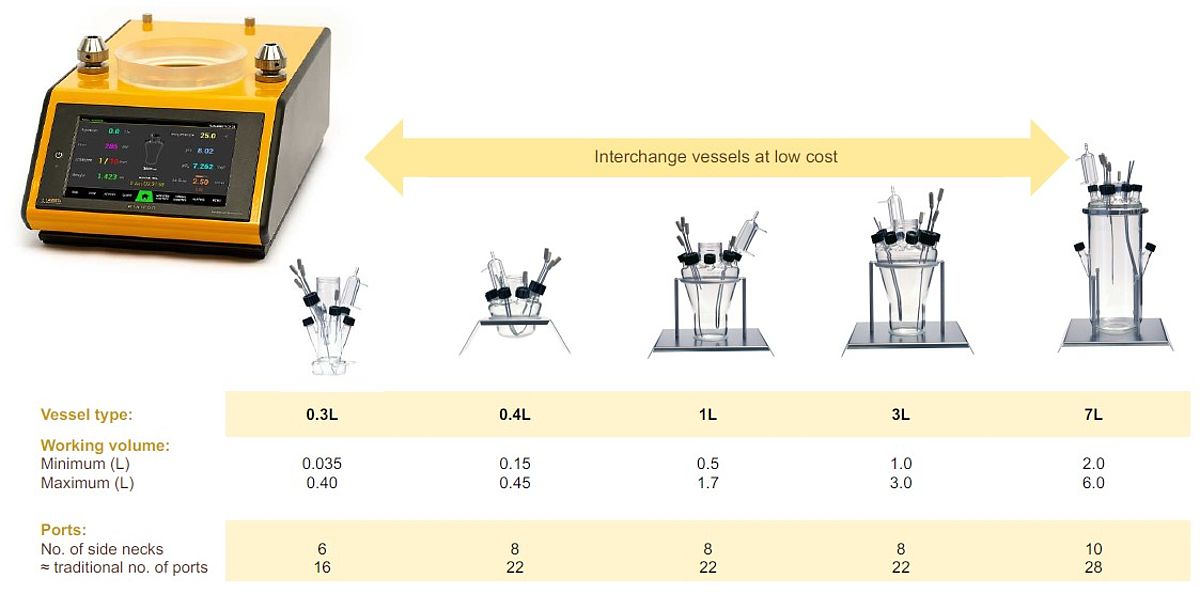
This flexibility provides major advantages:
Lower media and reagent costs during early-stage optimization
Efficient process development using small working volumes
Easy scale-up within the same bioreactor system
Consistent performance from research to process development
Cost-effective solution for cultured meat and cell culture applications
Suitable Bioreactor for Cultured Meat and Multiple Cell Types
Cultured meat production often involves not only animal cell culture, but also microorganisms such as yeast, microalgae, and bacteria, which are used to produce growth factors, nutrients, and supporting components. Therefore, selecting a bioreactor suitable for multiple cell types is essential.
The LAMBDA Minifor bioreactor is suitable for: Cultured meat cell cultivation, Mammalian cell culture, Stem cell research, Yeast cultivation, Microalgae cultivation, Bacterial fermentation etc.
This makes the Minifor a versatile lab-scale bioreactor suitable for cultured meat research, biotechnology, and alternative protein development.
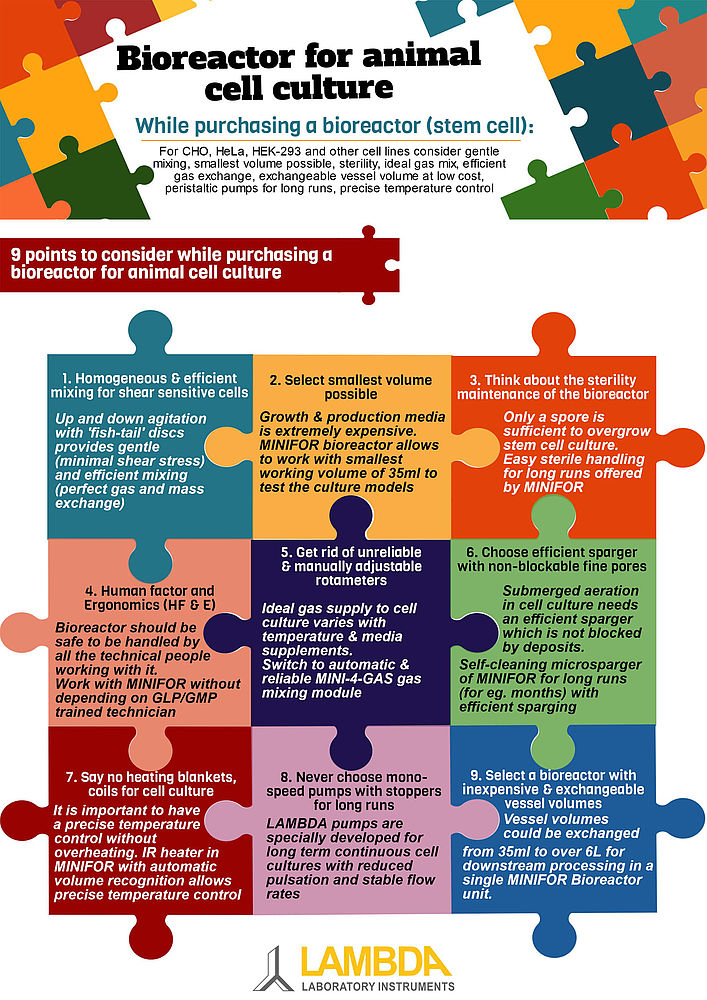
Figure: Practical Considerations for Choosing a Bioreactor for Stem Cell Cultivation and Cultured Meat Research
Ideal Lab-Scale Bioreactor for Cultured Meat Development
The LAMBDA Minifor bioreactor provides an advanced and reliable solution for cultured meat production and cell culture research. Its gentle biomimetic mixing technology, precise process control, flexible working volume, and multi-application capability make it an ideal choice for laboratories, research institutions, and biotechnology companies.
This bioreactor for cultured meat ensures high cell viability, stable cultivation conditions, and efficient process optimization, supporting the development of the next generation of cultured meat technologies.
Take your research to the next level with the LAMBDA Minifor2Bio touch Bioreactor. Discover its advanced capabilities and see how it can enhance your process development and laboratory workflows.
Learn more on our product page: www.lambda-instruments.com/fermenter-bioreactor-touch/
NEW! The latest Minifor2Bio touch laboratory fermenters-bioreactors are now available.
Read more at: fermenters.eu
For inquiries, quotations, or pricing information regarding our fermenter-bioreactor systems, please contact us at sales@lambda-instruments.com