Syringe pump
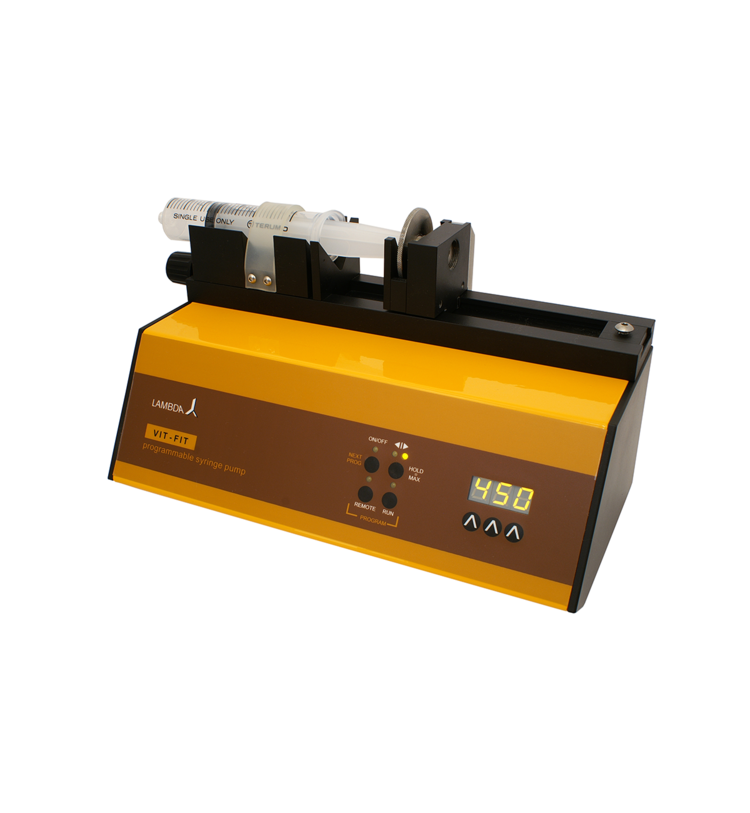
Syringe pump
High precision and excellent price/performance ratio.
Polyvalent programmable syringe pump - LAMBDA VIT-FIT
These days there are so many different types of syringes and so many different volumes used…
Some users need a standard syringe from a certain producer; others use only glass, metal or plastic syringes. Volumes start from a few microlitres to over 150 millilitres.
Is it possible to satisfy everybody with just a single syringe pump?
With our new VIT-FIT syringe pump, we have tried to solve just this problem.
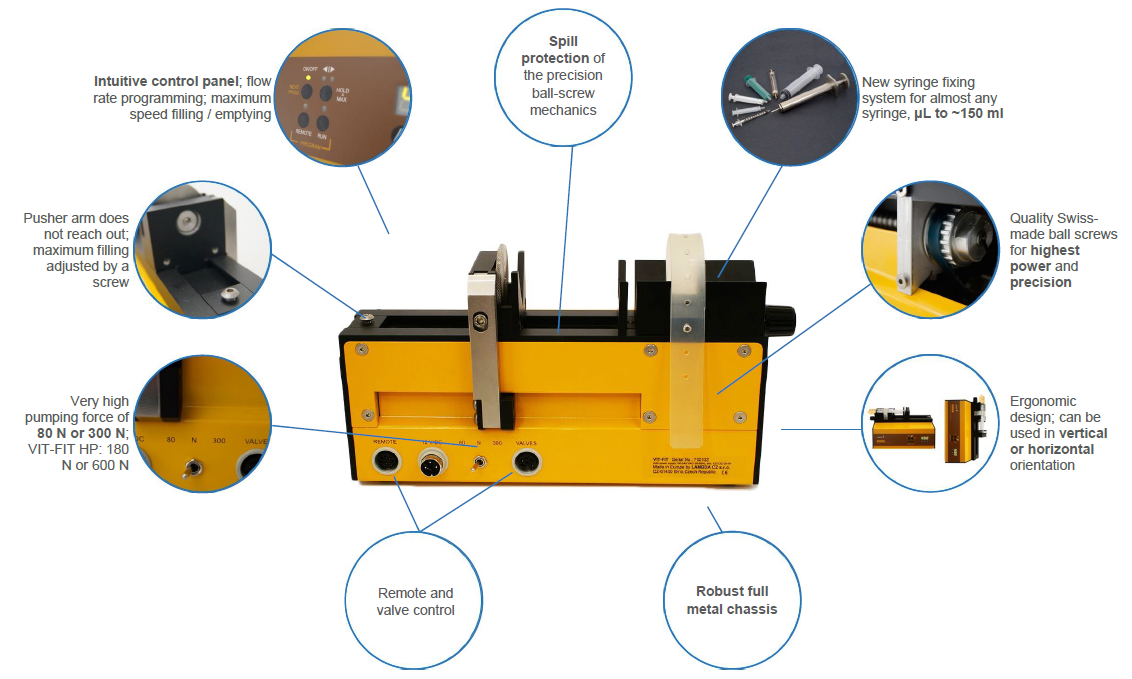
Our new syringe fixing system allows almost any syringe to be used, from micro syringes to large volume syringes, without the use of an adapter. The syringe is tightly held in both directions – infusion and filling.
In addition, the handling of the syringes is very easy.
Construction advantages and properties of the VIT-FIT (HP) syringe pumps
Precision mechanics for pulse-free operation
To move the pusher of the VIT-FIT syringe pumps and the VIT-FIT HP high-pressure syringe pumps, we have selected a Swiss made motor which uses new technology to ensure very high torque and ten times longer lifetime.
For the transformation of the rotation into a linear movement required for pushing the syringe plunger, we have introduced the Swiss made ball screws with highest mechanical load capacity. This is an expensive component in our instrument, but it offers decisive advantages to the user in terms of efficiency and mechanical yield/force of the system. This is crucial for a pulsation-free operation.
LAMBDA VIT-FIT and VIT-FIT high pressure lab syringe pumps are suitable for high-pressure, high-speed & counter pressure applications and handling of liquids with higher viscosity in the laboratory.
Metal chassis and protection
The precise mechanics is protected in the instrument casing and the pusher arm does not reach out from one side (as it is usual with existing syringe pumps), but is integrated into the rear of the instrument.
The casing and the main body of the syringe pump are made of metal with solvent resistant protection.
Programming flow profile (infusion and filling)
The microprocessor electronics allow control of the activity of the syringe pump in an easy but effective way. The movement of the new brushless neodymium magnet motor is constantly under the control of the microprocessor, which corrects immediately any deviation from the preset speed.
Up to 99 program steps can be memorized by the processor. The syringe pump can be programmed in both directions - delivery (infusion) and filling, locally on the syringe pump control display.
The program can be repeated in 1 to 99 cycles or endlessly.
- Constant flow rate: In this standard application of the syringe pump – the flow rate will be kept constant during the pre-selected time period
- Profile: Permits varying flow rates to be pre-programmed (including exponentially increasing flow rate as used for e.g. in feeding cultures during fermentation, etc.)
- Increment: Stepwise increase of the flow rate over time (to make gradients)
- Decrement: Stepwise decrease of the flow rate
- Pause: Stops the syringe pump for a specified time before going on to the next step
- Timer: By programming a required time interval with zero flow rate as the first step before the program the syringe pump can be automatically switched on or off
- Stop: Stops the syringe pump after the program has finished.
Safe switching power supply
As the mechanical losses are so small, we can use a miniature plug-integrated switching power supply using line voltages (from 95 to 240 V AC, 50/60 Hz).
During field application the syringe pump can be powered by a 12 V accumulator or a 12 V battery.
Automatic switch OFF
The motor of the syringe pump will be switched off automatically when the syringe is empty or has been refilled.
Remote control (analog and digital)
Several remote control possibilities of the syringe pump are available:
- Simple ON/OFF (with a 3 to 12 V DC signal or higher with resistor)
- Progressive speed control over the whole range signal 0 to 10 V DC, (0 to 20 or 4 to 20 mA option)
- RS-485 or RS-232 interface (option) for communication with a PC or similar device
Speed selection/syringe calibration
To be able to fit the many types of syringes used, the speed selection is made using speed numbers corresponding to the velocity of the rotation of the motor.
The selected syringe has to be calibrated. This means that the motor speed setting (000 to 999) has to be put into relation with the delivered volume as a function of time (flow rate). The flow rates and delivered volumes corresponding to each speed setting are then easily calculated.
Programming: up to 99 steps of speed and time
Time resolution: 0 to 999 minutes in 1 minute steps or 0 to 99.9 minutes in 0.1 minute steps: time resolution can be selected individually for each program step
Accuracy: ± 1%
Reproducibility: ± 0.2% (electronics)
Syringes: glass, plastic, metal syringes from 5 μl to over 150 ml
Flow rate: depends on the inner syringe diameter
Non-volatile memory: storage of all settings
Maximum force: VIT-FIT: 300 N (reducible by a switch to 80 N); VIT-FIT HP: 600 N (reducible by a switch to 160 N)
Motor: microprocessor controlled brushless long life BLDC motor with neodymium magnets
Transmission: efficient force transmission by a ball screw with highest mechanical load capacity of 12’000 N
Pusher travel: 120 mm
Pusher travel rate:
Minimum: 0.08 mm/min
Maximum: 80 mm/min
Speed control range: 0 to 999
Interface: RS-232 or RS-485 (optional)
Power supply: 95–240 V/50–60 Hz AC plug-in power supply with DC 12V/50W output; possible field operation on 12 V accumulator
Dimensions: 26.5 cm x 12.5 cm × 13 cm (W × D × H)
Weight: 3.2 kg
Safety: CE, meets IEC 1010/1 norm for laboratory instruments
Operation temperature: 0-40 °C
Operation humidity: 0-90% RH, not condensing
Remote control: 0-10 V; (option 0-20 or 4-20 mA)
- EN - VIT-FIT high-pressure syringe pump - infusion pump - Leaflet (pdf)
- EN - Operation manual - VIT-FIT high-pressure syringe pump - infusion pump (pdf)
- DE - Betriebsanleitung - VIT-FIT Spritzenpumpe - Infusionspumpe (pdf)
- DE - VIT-FIT Spritzenpumpe - Infusionspumpe - Prospekt (pdf)
- FR - Pousse-seringue VIT-FIT - brochure (pdf)
- FR - Mode d'emploi - LAMBDA VIT-FIT pousse seringue pompe à infusion (pdf)
- ES - Bomba de jeringa - Bomba de infusión VIT-FIT - folleto (pdf)
- ES - Instrucciones de operación - Bomba de jeringa - Bomba de infusión VIT-FIT (pdf)
- CZ - LAMBDA VIT-FIT stříkačková pumpa - leták (pdf)
- CZ - Návod k použití - LAMBDA VIT-FIT stříkačková pumpa (pdf)
2025
LAMBDA VIT-FIT (HP) syringe pumps with 120 ml sterile polypropylene syringe (luer slip connection to tubing) and 20 ml polypropylene syringe (sterile catheter cone connection to tubing) controlling flow rates (100 ml/min for aqueous and 10 ml/min for organic streams) during steady-state transition (30 seconds) in flash nanoprecipitation for polymeric nanoparticle synthesis.
Bandyopadhyay, S., Zafar, H., Khan, M. S., Ansar, R., Peddis, D., Slimani, S., Bali, N., Sajid, Z., Qazi, R. M., Rehman, F. & Mian, A. A. (2025). Hydrophobic iron oxide nanoparticles: Controlled synthesis and phase transfer via flash nanoprecipitation. Journal of Colloid and Interface Science, 678, 873-885.
https://doi.org/10.1016/j.jcis.2024.09.134
2024
Controlled monomer addition using LAMBDA VIT-FIT syringe pump at 2 ml/min for polymethyl methacrylate (PMMA) nanoparticle synthesis.
Romann, P., Trunov, D., Srom, O., Lee, H. L., Lee, K. S., Trocki, R., Ephraim, D., Bielser, J.-M., Souquet, J., Soos, M. & Villiger, T. K. (2024). Experimental Determination of Maximum Shear Stress in Mobius® Breez Perfusion Microbioreactors and Comparative Analysis with Stirred Tank Bioreactors. Biochemical Engineering Journal, 109556.
https://doi.org/10.1016/j.bej.2024.109556
In the HPLC system, a polyvalent programmable LAMBDA VIT-FIT syringe pump was used for delivering the acceptor solution to the sample loop.
Noori, N., Asghari, A., Haghgoo Qezelje, H., Rajabi, M., Memarian, F., & Hosseini-Bandegharaei, A. (2024). Continuous flow membrane microextraction as a clean method for detecting codeine and papaverine in biological samples using HPLC-UV. Canadian Journal of Chemistry.
https://doi.org/10.1139/cjc-2023-0189
LAMBDA VIT-FIT syringe pumps controlled and supplied the fluids (PDMS and DI water with blue ink) to the channels of the experimental microfluidic device setup, with volumetric flow rates in the range of 0.05 – 5 ml/min.
Oldach, B., Fortmann, R., Pleie, T., Timm, P., & Kockmann, N. (2024). Design and Rapid Prototyping of 3D-Printed Microfluidic Systems for Multiphase Flow. Chemistry, 6(6), 1458-1476.
https://doi.org/10.3390/chemistry6060088
Device design for continuous liquid–liquid separation and open source automation technology: LAMBDA VIT-FIT syringe pumps were used for fluid supply in a droplet-based microfluidics experimental setup for separation of segmented flows (dipersed phase: deionized water; continuous phase: polydimethylsiloxane (PDMS)).
Oldach, B., Chiang, Y. Y., Ben-Achour, L., Chen, T. J., & Kockmann, N. (2024). Performance of different microfluidic devices in continuous liquid-liquid separation. Journal of Flow Chemistry, 1-11.
https://doi.org/10.1007/s41981-024-00326-z
To investigate the interactions between the piston ring, cylinder liner and lubricant, a syringe pump LAMBDA VIT-FIT was used for lubrication supply. "The tilted system and precise pumps allowed to adjust the very low and continuous flow of heated oil through the tribological contact."
Markut, T., Summer, F., Pusterhofer, M., & Grün, F. (2024). Emergence of Coated Piston Ring Scuffing Behavior on an Application-Oriented Tribological Model Test System. Lubricants, 12(6), 218.
https://doi.org/10.3390/lubricants12060218
For the experimental investigation, a LAMBDA VIT-FIT (HP) syringe pump was used for the liquid and a meros high-speed digital microscope to record the movement of the particles.
Ghadamgahi, S. M. E., Shahmardan, M. M., Nazari, M., Mansouri, H., & Hashemi, N. N. (2024). Numerical and experimental investigation of the deviation of microparticles inside the microchannel using the vortices caused by the ICEK phenomenon. Electrophoresis, 45(7-8), 720-734.
https://doi.org/10.1002/elps.202300151
A LAMBDA VIT-FIT syringe pump fed the precursor solution to a twin-fluid FSP atomizer at a flow rate of 5 ml/min.
Deligiannakis, Y., Bletsa, E., Mouzourakis, E., Solakidou, M., & Adamska, K. (2024). Carbon-Coated TiO2 Nanoparticles for Noble-Metal-Free Photocatalytic H2 Production from H2O. ACS Applied Nano Materials.
https://doi.org/10.1021/acsanm.4c01150
Experimental calorimeter setup for the measurement of metal-sensitive reactions: Two pumps (a HiTec Zang SyrDos and a LAMBDA VIT-FIT) are used to introduce the feed solutions into the calorimeter. For the unbiased calculation of the reaction enthalpy per mol, a third pump (LAMBDA VIT-FIT) is used to quench the reaction after the calorimetric measurement is concluded.
Soritz, S., Sommitsch, A., Irndorfer, S., Brouczek, D., Schwentenwein, M., Priestley, I. J. G., Iosub, A. V., Krieger, J. P., & Gruber-Woelfler, H. (2024). Thermokinetic analyses of metal-sensitive reactions in a ceramic flow calorimeter. Reaction Chemistry & Engineering.
https://doi.org/10.1039/D4RE00014E
Laboratory of equipment design: Add-on to extend the capacity of the laboratory syringe pump LAMBDA VIT-FIT to two syringes (HENKE-JECT® Luer Lock 50 mL)
Höving, S., Ronnewinkel, P., & Kockmann, N. (2024). From Batch to Continuous Small-Scale Production of Particles: Mixer Design Methodology for Robust Operation. Crystals, 14(5), 398.
https://doi.org/10.3390/cryst14050398
Figure: https://pub.mdpi-res.com/crystals/crystals-14-00398/article_deploy/html/images/crystals-14-00398-g0A1.png (2024 April 30)
The syringe pump LAMBDA VIT-FIT/VIT-FIT HP with a Hamilton syringe (diameter 0.82 mm, volume 25 μl) injects the fluid containing the yeast particles into the microchannel.
Aghdasi, M., Nazari, M., Holari, S. Y., & Hashemi, N. N. (2024). Designing a new microchannel to collect microparticles using dielectrophoretic forces: Numerical and experimental investigation. Journal of Electrostatics, 127, 103879.
https://doi.org/10.1016/j.elstat.2023.103879
2023
The solution is injected into the microchannel by using a LAMBDA VIT-FIT HP syringe pump with a flow rate of 0.0353 µl/s.
Aghdasi, M., Nazari, M., & Yonesi, S. (2023). A novel micro-device for simultaneous separation-trapping and double-trapping of particles by using dielectrophoresis: numerical and experimental study. Journal of Micromechanics and Microengineering, 33(10), 105015.
https://doi.org/10.1088/1361-6439/acef32
Microprocess engineering for microfluidic applications with microcontroller board for access and control of the system actuators: a) syringe pumps with RS-232 interface; b) valves (located between syringe pumps and inlets of the microfluidic devices). The LAMBDA VIT-FIT syringe pumps delivered the non-miscible liquids with individually adjustable flow rates (0.1 - 10 ml/min) for various liquid-liquid flow patterns, while the remote-controlled switching of the valve positions supplied the desired geometries with fluid.
Oldach, B., Höving, S., Boettcher, K. E., & Kockmann, N. (2023, March). Ultra-concurrent remote laboratory for microfluidic applications. In International Conference on Remote Engineering and Virtual Instrumentation (pp. 463-476). Cham: Springer Nature Switzerland.
https://doi.org/10.1007/978-3-031-42467-0_43
The programmable LAMBDA VIT-FIT syringe pump with a 120 ml syringe pumped the solution (total volume 800 ml): Pump rate 1.2 ml/s; pumping time 2 minutes (1 minute to fill and 1 minute to empty the syringe).
Svara, D., Filipova, B., Jelinek, P., Mikes, P., Kluk, A., & Soós, M. (2023). The impact of polymer mixture composition on the properties of electrospun membranes for drug delivery applications. International Journal of Pharmaceutics, 647, 123548.
https://doi.org/10.1016/j.ijpharm.2023.123548
A pulse injection of an inert tracer potassium bromide was introduced at the inlet (c0,KBr = 0.303 mol/m3; Q = 5 mL/min; total V = 100 mL) with a syringe pump LAMBDA VIT-FIT.
Markale, I., Carrel, M., Kurz, D. L., Morales, V. L., Holzner, M. & Jiménez-Martínez, J. (2023). Internal Biofilm Heterogeneities Enhance Solute Mixing and Chemical Reactions in Porous Media. Environmental Science & Technology 2023 57 (21), 8065-8074
https://doi.org/10.1021/acs.est.2c09082
LAMBDA VIT-FIT syringe pump for water injection 2.1 ml/h, 4.3 ml/h and 6.4 ml/h (line connected to a solenoid valve controlled by a timer) as part of the microfluidic experimental setup: WAG (Water Alternating Gas) injection for oil displacement in porous media using four different displacing fluids including Gas (N2), Water, WAG and Coinjection of liquid and gas.
Jafarian, K., Kayhani, M.H., Nazari, M., Ghorbanbakhsh, B. & Shokri, N. (2023). WAG injection in porous media: A microfluidic analysis. Chemical Engineering Research and Design, Volume 193, 2023, Pages 649-659, ISSN 0263-8762,
https://doi.org/10.1016/j.cherd.2023.03.035
Feeding of reactants into the microreactor via two LAMBDA VIT-FIT syringe pumps (connected to lab automation system LabManager & automation software LabVision)
Frede, T.A., Weber, C., Brockhoff, T., Christ, T., Ludwig, D. & Kockmann, N. (2023). Data Management of Microscale Reaction Calorimeter Using a Modular Open-Source IoT-Platform. Processes 2023, 11, 279.
https://doi.org/10.3390/pr11010279
To allow fluid flow through the dielectrophoretic microfluidic device, a LAMBDA VIT-FIT syringe pump was connected.
Valijam, S., Nilsson , D.P.G., Malyshev, D., Öberg, R., Salehi, A. & Andersson, M. (2023). Fabricating a dielectrophoretic microfluidic device using 3D-printed moulds and silver conductive paint.
https://doi.org/10.48550/arXiv.2302.10690
A LAMBDA VIT-FIT syringe pump was used to fill the porcine small intestine with DI water (1 ml/min).
Cipolato, O., Dosnon, L., Rosendorf, J., Sarcevic, S., Bondi, A., Liska, V., Schlegel, A.A. & Herrmann I.K. (2023). Nanothermometry-enabled intelligent laser tissue soldering. bioRxiv 2023.03.03.530945;
https://doi.org/10.1101/2023.03.03.530945
2022
LAMBDA VIT-FIT Syringe pumps were used to feed the individually preheated reactants from storage flasks through temperature controlled FEP tubing into the microreactor.
Frede, T.A., Greive, M. & Kockmann, N. (2022). Measuring Kinetics in Flow Using Isoperibolic Flow Calorimetry. Reactions 2022, 3, 525–536.
https://doi.org/10.3390/reactions3040035
The syringe injection pump LAMBDA VIT-FIT was used to inject operating fluid free of bubbles into a microchannel inlet via silicone capillary tubes of a 1.0 mm diameter.
Tavari, T., Meamardoost, S., Sepehry, N., Sepehry, N., Akbarzadeh, P., Nazari, M., Hashemi, N.N. & Nazari, M. (2022). Effects of 3D electrodes arrangement in a novel AC electroosmotic micropump: Numerical modeling and experimental validation. Electrophoresis. 2022; 1– 12.
https://doi.org/10.1002/elps.20220021
2021
The LAMBDA VIT-FIT syringe pump injects MMA/EGDMA (80%/20%) monomer mixture into the polymerization reactor using a feed rate of 2.5 mL/min.
Wilson, J. F., Zahradnik, B., Šrom, O., Jaquet, B., Hassouna, F., Hrdlicka, Z., Kosek, J., & Šoóš, M. (2021). Study of the shear-thinning effect between polymer nanoparticle surfaces during shear-induced aggregation. Industrial & Engineering Chemistry Research, 60(29), 10654-10665.
https://doi.org/10.1021/acs.iecr.1c00232
200 µL of the diluted and spiked rainbow trout plasma were pumped through a PDMS coated capillary with defined flow rates (24–0.2 ml/h) using a syringe pump LAMBDA VIT-FIT.
Krause, S. & Goss, K. U. (2021). Could chemical exposure and bioconcentration in fish be affected by slow binding kinetics in blood? Environmental Science: Processes & Impacts, 2021, Advance Article;
https://doi.org/10.1039/d1em00056j
Polyimide‐foil‐based microfluidic mixing: LAMBDA VIT-FIT syringe pumps with 50-mL syringes (Henke-Ject) for 25 °C preheated feed.
Bobers, J., Forys, E., Oldach, B., & Kockmann, N. (2021). Application of Polyimide‐based Microfluidic Devices on Acid‐catalyzed Hydrolysis of Dimethoxypropane. Chemie Ingenieur Technik, 93(5), 796-801.
https://doi.org/10.1002/cite.202000224
LAMBDA VIT-FIT pumps isoamyl alcohol (> 98.5 %) at continuous volumetric flow rates (10, 20, 30, 40, 80, 227.9 μl/min) with a 50 ml syringe into a thermal insulated water bath with microreactor setup.
Lee, C. S., Vorwerk, C., Azudin, N. Y., Ahmad, N. A., & Abd Shukor, S. R. (2021). Kinetics modelling of uncatalyzed esterification of acetic anhydride with isoamyl alcohol in a microreactor system. Journal of Environmental Chemical Engineering, 9(3), 105219.
https://doi.org/10.1016/j.jece.2021.105219
A LAMBDA VIT-FIT syringe pump is equipped with a 50 mL stainless steel syringe filled with a 10 mM stock solution of coumaric acid (substrate). The outlets of two pumps are connected to a static mixer, in order to provide a feed stream with uniform concentration before it reaches the column inlet.
Valotta, A., Maier, M. C., Soritz, S., Pauritsch, M., Koenig, M., Brouczek, D., Schwentenwein, M. & Gruber-Woelfler, H. (2021). 3D printed ceramics as solid supports for enzyme immobilization: an automated DoE approach for applications in continuous flow. Journal of Flow Chemistry, 11(3), 675-689.
https://doi.org/10.1007/s41981-021-00163-4
Pure water is pumped using a BlueShadow and pure water enriched with potassium iodide (KI) is pumped by LAMBDA VIT-FIT into the rotating helically coiled tube (HCT) that is mounted into the computed tomography scanner (Skyscan 1275).
Schuler, J., Herath, J., & Kockmann, N. (2021). 3D investigations of microscale mixing in helically coiled capillaries. Journal of Flow Chemistry, 11, 217-222.
https://doi.org/10.1007/s41981-021-00161-6
2017
Constant and reproducible flow rates of 26 ± 2 nL/s created by microfluidic LAMBDA VIT-FIT syringe pump equipped with a 10 μl pipette
Zhang, H., Stangner, T., Wiklund, K., Rodriguez, A., & Andersson, M. (2017). UmUTracker: A versatile MATLAB program for automated particle tracking of 2D light microscopy or 3D digital holography data. Computer Physics Communications, 219, 390-399.
https://doi.org/10.1016/j.cpc.2017.05.029
2016
For nanopowder synthesis, the precursor solution (in ethanol) was fed into the water-cooled FASP nozzle using a constant flow rate LAMBDA VIT-FIT syringe pump and dispersed with 3 – 6 L/min O2 while maintaining a pressure drop of 1.6 – 1 .8 bar at the nozzle.
Posavec, L., Knijnenburg, J. T., Hilty, F. M., Krumeich, F., Pratsinis, S. E., & Zimmermann, M. B. (2016). Dissolution and storage stability of nanostructured calcium carbonates and phosphates for nutrition. Journal of Nanoparticle Research, 18, 1-13.
https://doi.org/10.1007/s11051-016-3608-6
LAMBDA VIT-FIT syringe pump used to pump the precursor solution (in A) toluene, B) diethylene glycol monobutyl ether & acetic anhydride or C) toluene, 2-ethylhexanoate & acetonitrile (3:1:1)) at a rate of 5 ml/min into the flame reactor nozzle
Koirala, R., Buechel, R., Pratsinis, S. E., & Baiker, A. (2016). Silica is preferred over various single and mixed oxides as support for CO2-assisted cobalt-catalyzed oxidative dehydrogenation of ethane. Applied Catalysis A: General, 527, 96-108.
https://doi.org/10.1016/j.apcata.2016.08.032
LAMBDA VIT-FIT syringe pumpto feed the precursor solution (iron(III) acetylacetonate in xylene and acetonitrile (volume ratio 3:1) with a total iron concentration of 0.34 M) at 5 ml/min for the synthesis of magnetic nanoparticles
Teleki, A., Haufe, F. L., Hirt, A. M., Pratsinis, S. E., & Sotiriou, G. A. (2016). Highly scalable production of uniformly-coated superparamagnetic nanoparticles for triggered drug release from alginate hydrogels. RSC advances, 6(26), 21503-21510.
https://doi.org/10.1039/C6RA03115C
LAMBDA VIT-FIT syringe pump for spray-drying of an aqueous solution containing HDM allergen and lactose to generate aerosol
Lüer, K., Biller, H., Casper, A., Windt, H., Müller, M., Badorrek, P., Haefner, D., Framke, T., Koch, A., Ziehr, H., Krug, N., Koch, W., & Hohlfeld, J. M. (2016). Safety, efficacy and repeatability of a novel house dust mite allergen challenge technique in the Fraunhofer allergen challenge chamber. Allergy, 71(12), 1693-1700.
https://doi.org/10.1111/all.12947
Burst pressure measurement: The cannula was fixed to a three-way stopcock connected to a pressure-measuring device (GMH 5130) with pressure sensors (MSD 1 BRE, range 0–1 bar, GHM Messtechnik) and an infusion pump (LAMBDA VIT-FIT), which was infusing saline solution at a constant rate of 200 ml/min.
Holmer, C., Winter, H., Nagel, A., Jaenicke, A., Lauster, R., Kraft, M., Buhr, H. J., Ritz, J.-P., & Zickerow, M. (2016). Bipolar radio-frequency-induced thermofusion of intestinal tissue–In vivo evaluation of a new fusion technique in an experimental study. International Journal of Hyperthermia, 32(5), 583-586.
https://doi.org/10.3109/02656736.2016.1168872
2015
LAMBDA VIT-FIT syringe pump used to deliver the liquid feed solutions at a Qlf of 1 ml/min to the nozzles of the spray dryer
Schäfer, J. (2015). Spray-Drying of Enzymes on the Bench-Top Scale with lengthened Chamber Retention Time (Doctoral dissertation, Erlangen, Friedrich-Alexander-Universität Erlangen-Nürnberg (FAU), Diss., 2015).
URI: https://open.fau.de/handle/openfau/5935 (2024 April 22)
Cyclic bending tests of Ag–PMMA nanocomposite films were conducted by programmable motor of LAMBDA VIT-FIT syringe pump
Blattmann, C. O., Sotiriou, G. A., & Pratsinis, S. E. (2015). Rapid synthesis of flexible conductive polymer nanocomposite films. Nanotechnology, 26(12), 125601.
https://doi.org/10.1088/0957-4484/26/12/125601
Programmable LAMBDA VIT-FIT syringe pump was used to add the methyl methacrylate (MMA) at a flow rate of 0.1 g/min to synthesis the poly(methyl methacrylate) (PMMA) nanoparticles.
Villiger, T. K., Morbidelli, M., & Soos, M. (2015). Experimental determination of maximum effective hydrodynamic stress in multiphase flow using shear sensitive aggregates. AIChE Journal, 61(5), 1735-1744.
https://doi.org/10.1002/aic.14753
Precursor solutions (gallium acetylacetonate and titanium isopropoxide dissolved in xylene) were injected at 5 ml/min by LAMBDA VIT-FIT syringe pump through the FSP nozzle to investigate the catalytic behaviour of TiO2 supported Ga2O3 in ODHE.
Koirala, R., Buechel, R., Krumeich, F., Pratsinis, S. E., & Baiker, A. (2015). Oxidative dehydrogenation of ethane with CO2 over flame-made Ga-loaded TiO2. ACS Catalysis, 5(2), 690-702.
https://doi.org/10.1021/cs500685d
2014
Syringe pump LAMBDA VIT-FIT connected to a diffuser (wood or ceramic) with selected speed of 0.8 mm/min, used for homogeneous dispersion of bubbles
Souzy, N. (2014). Experimental study and improvement of mass transfer in vertical bubble columns (Doctoral dissertation, Lyon 1).
https://theses.hal.science/tel-01127296 (2024 April 22)
To prepare the macroporous microparticles, aggregation was induced under shear stress under defined stirring speed by adding equal volumes of saline solutions during two successive gradients (2 × 10 ml) using a programmable syringe pump (LAMBDA VIT-FIT) at a defined flow rate.
Lamprou, A., Köse, I., Peña Aguirre, Z., Storti, G., Morbidelli, M., & Soos, M. (2014). Macroporous polymer particles via reactive gelation under shear: effect of primary particle properties and operating parameters. Langmuir, 30(46), 13970-13978.
https://doi.org/10.1021/la502153j
Flow rate of coffee extract held constant at 1 ml/min by programmable syringe pump LAMBDA VIT-FIT to study the deposition kinetics of an industrial coffee extract over a wide range of temperatures
Kroslak, M., Morbidelli, M., & Sefcik, J. (2014). Effects of temperature and concentration on mechanism and kinetics of thermally induced deposition from coffee extracts. Chemical Papers, 68(12), 1755-1766.
https://doi.org/10.2478/s11696-014-0628-5
Flame spray pyrolysis (FSP): LAMBDA VIT-FIT syringe pump was used to inject (5 ml/min) and disperse the precursor solution into fine droplets by co-flowing 5 L/min of O2 maintaining a pressure drop of 2 bar at the nozzle tip.
Koirala, R., Büchel, R., Pratsinis, S. E., & Baiker, A. (2014). Oxidative coupling of methane on flame-made Mn-Na2WO4/SiO2: Influence of catalyst composition and reaction conditions. Applied Catalysis A: General, 484, 97-107.
https://doi.org/10.1016/j.apcata.2014.07.013
Two monomeric mixtures were fed at a rate of 0.056 ml/min for latex preparation followed by induced aggregation under shear by addition of gradient salts at a rate of 4.23 ml/min using LAMBDA VIT-FIT programmable syringe pumps for the synthesis of macroporous copolymer resins
Alexandros, L., Itır, K., Giuseppe, S., Massimo, M., & Miroslav, S. (2014). Synthesis of Macroporous Polymer Particles Using Reactive Gelation under Shear. Langmuir 2014 30 (23), 6946-6953
https://doi.org/10.1021/la5000793
Programmable syringe pump (LAMBDA VIT-FIT) filled with SF6 used for continuous infusion of microbubbles (MBs) into rabbits
Lukáč, R. (2014). Micro and Nanoparticles as Drug Carriers: Surface-Modified Microbubbles Used as Ultrasound Contrast Agents and Drug Carriers (Doctoral dissertation, Masarykova univerzita, Přírodovědecká fakulta).
http://is.muni.cz/th/271136/prif_d/Robert_Lukac.pdf (2024 April 22)
The cytochrome c (cyt c) solution was injected into the ternary lipid membranes of the flow chamber system using a LAMBDA VIT-FIT programmable syringe pump at a sufficiently low speed that the system was not disturbed by liquid flow to study the phase behavior.
Pataraia, S., Liu, Y., Lipowsky, R., & Dimova, R. (2014). Effect of cytochrome c on the phase behavior of charged multicomponent lipid membranes. Biochimica et Biophysica Acta (BBA)-Biomembranes, 1838(8), 2036-2045.
https://doi.org/10.1016/j.bbamem.2014.04.019
Monomer addition was controlled by a programmable syringe pump LAMBDA VIT-FIT
Codari, F., Moscatelli, D., Furlan, M., Lattuada, M., Morbidelli, M., & Soos, M. (2014). Synthesis of Hetero-nanoclusters: The Case of Polymer–Magnetite Systems. Langmuir, 30(8), 2266-2273.
https://doi.org/10.1021/la5001039
"A perfusor (LAMBDA VIT-FIT polyvalent syringe infusion pump) controlled syringe injected the MCh solution via a dispersion nozzle (Fraunhofer ITEM) operated with pressurized air into a custom-made evaporation chamber (140 mm diameter and 350 mm length) that was warmed up to 313.2 K."
Curths, C., Wichmann, J., Dunker, S., Windt, H., Hoymann, H. G., Lauenstein, H. D., Hohlfeld, J., Becker, T., Kaup, F. J., Braun, A., & Knauf, S. (2014). Airway hyper-responsiveness in lipopolysaccharide-challenged common marmosets (Callithrix jacchus). Clinical science, 126(2), 155-162.
https://doi.org/10.1042/CS20130101
2013
Water injection at a flow rate of 200 μl/min with a LAMBDA VIT-FIT programmable syringe pump
Aüllo, T. (2013). Atténuation naturelle potentielle de BTEX en aquifère de stockage de gaz (Doctoral dissertation, Pau).
https://theses.fr/2013PAUU3018 (2024 April 23)
Delivering of the precursor solution to the flame by the LAMBDA VIT-FIT syringe pump at a rate of 5 ml/min
Wallace, R., Brown, A. P., Brydson, R., Wegner, K., & Milne, S. J. (2013). Synthesis of ZnO nanoparticles by flame spray pyrolysis and characterisation protocol. Journal of Materials Science, 48, 6393-6403.
https://doi.org/10.1007/s10853-013-7439-x
Maintaining of fluid circulation in the inverted microscope by LAMBDA VIT-FIT syringe pump
Mbaye, S., Séchet, P., Pignon, F., & Martins, J. M. F. (2013). Influence of hydrodynamics on the growth kinetics of glass-adhering Pseudomonas putida cells through a parallel plate flow chamber. Biomicrofluidics, 7(5).
https://doi.org/10.1063/1.4821244
Construction of a microfuidic adhesion cell: Feeding of fluid to the flow cell through Tygon hoses connected to a syringe pump LAMBDA VIT-FIT
Tokárová, V., Pittermannová, A., Král, V., Řezáčová, P., & Štěpánek, F. (2013). Feasibility and constraints of particle targeting using the antigen–antibody interaction. Nanoscale, 5(23), 11490-11498.
https://doi.org/10.1039/C3NR04340A
Mounting of the initiator solution by two programmable single syringe pumps LAMBDA VIT-FIT
Diederich, V. E., Studer, P., Kern, A., Lattuada, M., Storti, G., Sharma, R. I., Snedeker, J. G., & Morbidelli, M. (2013). Bioactive polyacrylamide hydrogels with gradients in mechanical stiffness. Biotechnology and bioengineering, 110(5), 1508-1519.
https://doi.org/10.1002/bit.24810
Continuous infusion of microbubbles with the LAMBDA VIT-FIT programmable syringe pump
Kauerová, Z., Lukáč, R., Kohout, P., Mašek, J., Koudelka, Š., Plocková, J., Vašíčková , M., Vlašín, M., & Turánek, J. (2013). A prototype ‘Infucon’device for continuous infusion of microbubbles in vivo. International journal of pharmaceutics, 441(1-2), 92-98.
https://doi.org/10.1016/j.ijpharm.2012.12.026
Acid dosage in the experimental setup: Using a LAMBDA VIT-FIT syringe pump, concentrated sulfuric or perchloric acid was injected via a needle (outlet diameter 500 mm) near the impeller of the stirred tank reactor
Kölbl, A., Desplantes, V., Grundemann, L., & Scholl, S. (2013). Kinetic investigation of the Dushman reaction at concentrations relevant to mixing studies in stirred tank reactors. Chemical engineering science, 93, 47-54.
https://doi.org/10.1016/j.ces.2013.01.067
Aerosol Science and Technology: LAMBDA VIT-FIT HP injection system for production of aerosol with Bacillus thuringiensis spores
Roux, J. M., Kaspari, O., Heinrich, R., Hanschmann, N., & Grunow, R. (2013). Investigation of a new electrostatic sampler for concentrating biological and non-biological aerosol particles. Aerosol Science and Technology, 47(5), 463-471.
https://doi.org/10.1080/02786826.2013.763896
2012
Using of the LAMBDA VIT-FIT syringe pump during intravitreal injection of rotenone (5 and 15 mM in DMSO) or DMSO (vehicle)
Heitz, F. D., Erb, M., Anklin, C., Robay, D., Pernet, V., & Gueven, N. (2012). Idebenone Protects against Retinal Damage and Loss of Vision in a Mouse Model of Leber's Hereditary Optic Neuropathy. PLoS ONE, 7(9), e45182-e45182.
https://doi.org/10.1371/journal.pone.0045182
"The precursor solution was fed at 2−6 mL/min through the FASP or FSP spray nozzles by a LAMBDA VIT-FIT syringe pump and atomized by coflowing 6 L/min of oxygen at 1.5 bar pressure drop."
Rudin, T., & Pratsinis, S. E. (2012). Homogeneous iron phosphate nanoparticles by combustion of sprays. Industrial & engineering chemistry research, 51(23), 7891-7900.
https://doi.org/10.1021/ie202736s
Comparison of surgical scissors on a pig model: Saline infusion kept constant by LAMBDA VIT-FIT syringe-pump
Seehofer, D., Mogl, M., Boas-Knoop, S., Unger, J., Schirmeier, A., Chopra, S., & Eurich, D. (2012). Safety and efficacy of new integrated bipolar and ultrasonic scissors compared to conventional laparoscopic 5-mm sealing and cutting instruments. Surgical endoscopy, 26, 2541-2549.
https://doi.org/10.1007/s00464-012-2229-0
Experimental set-up with custom-designed adhesion cell and a LAMBDA VIT-FIT syringe pump with heated fluid in the syringe to control the volumetric flow rate.
Tokárová, V., Pittermannová, A., Čech, J., Ulbrich, P., & Štěpánek, F. (2012). Thermo-responsive adhesion properties of composite hydrogel microcapsules. Soft matter, 8(4), 1087-1095.
https://doi.org/10.1039/c1sm06783d
2011
Slow injection of CdCl2 solution into the chamber containing Na2S-loaded GUVs without detaching the vesicles from the substrate, done by polyvalent LAMBDA VIT-FIT syringe pump (at a speed of 1 ml/min).
Yang, P., & Dimova, R. (2011). Nanoparticle synthesis in vesicle microreactors. In Biomimetic based applications (pp. 523-552). InTech.
https://pure.mpg.de/rest/items/item_1925392/component/file_3274796/content (2024 April 22)
The syringe pump was used to provide a constant flow rate of liquid through the nozzle to analyze the breakage and restructuring of colloidal aggregates in dilute conditions under shear.
Harshe, Y. M., Lattuada, M., & Soos, M. (2011). Experimental and modeling study of breakage and restructuring of open and dense colloidal aggregates. Langmuir, 27(10), 5739-5752.
https://doi.org/10.1021/la1046589
Pumping of sample solution at a speed of 8 μl/min through an insulating Teflon tubing to the steel spraying capillary with a LAMBDA VIT-FIT syringe pump
Büttiker, R., Ebert, J., Hinderling, C., & Adlhart, C. (2011). Membranes for specific adsorption: immobilizing molecularly imprinted polymer microspheres using electrospun nanofibers. Chimia, 65(3), 182-186.
https://doi.org/10.2533/chimia.2011.182
Dosing of fluids with LAMBDA VIT-FIT syringe pumps for reliably assessment of protein structures under various conditions
Prim, D., Crelier, S., & Segura, J. M. (2011). Coupling of a Microfluidic Mixer to a Fourier-transform Infrared Spectrometer for Protein-Conformation Studies. FH–HES. Chimia, 65(10), 815-815.
https://doi.org/10.2533/chimia.2011.815
LAMBDA VIT-FIT syringe pump as the final control element in order to manipulate the flow rate of the injected strong base into the microreactor
Abd Shukor, S. R., Barzin, R., & Ahmad, A. L. (2011). Computer-Based Control for Chemical Systems Using LabVIEW® in Conjunction with MATLAB®. Practical Applications and Solutions Using LabVIEW™ Software, 363.
https://doi.org/10.5772/19414
LAMBDA VIT-FIT infusion pump for inflated colon samples
Holmer, C., Winter, H., Kröger, M., Nagel, A., Jaenicke, A., Lauster, R., Kraft, M., Buhr, H. J., & Ritz, J. P. (2011). Bipolar radiofrequency-induced thermofusion of intestinal anastomoses—feasibility of a new anastomosis technique in porcine and rat colon. Langenbeck's archives of surgery, 396, 529-533.
https://doi.org/10.1007/s00423-011-0756-0
The solution was fed with a LAMBDA VIT-FIT syringe pump at 2 ml/min through the spray nozzle (capillary inner/outer diameter 0.41/0.72 mm) and by co-flowing 6 L/min oxygen through a surrounding annulus (0.97 mm o.d.) at a pressure drop of 1.5 bar.
Rudin, T., Wegner, K., & Pratsinis, S. E. (2011). Uniform nanoparticles by flame-assisted spray pyrolysis (FASP) of low cost precursors. Journal of Nanoparticle Research, 13, 2715-2725.
https://doi.org/10.1007/s11051-010-0206-x
2010
LAMBDA VIT-FIT syringe pump was used to investigate the breakup of dense aggregates in an extensional flow through a contracting nozzle
Soos, M., Ehrl, L., Bäbler, M. U., & Morbidelli, M. (2010). Aggregate breakup in a contracting nozzle. Langmuir, 26(1), 10-18.
https://doi.org/10.1021/la903982n
Using a LAMBDA VIT-FIT syringe pump as the final control element in order to manipulate the flow rate of sodium hydroxide into the SSIMM micro-reactor
Barzin, R., Abd Shukor, S. R., & Ahmad, A. L. (2010). New spectrophotometric measurement method for process control of miniaturized intensified systems. Sensors and Actuators B: Chemical, 146(1), 403-409.
https://doi.org/10.1016/j.snb.2010.01.072
LAMBDA VIT-FIT syringe pump with a driving force of 300 N is used with the advantage that different syringes run with this type and the driving velocity can be chosen in 0 and 999 increments. The characteristic functions of four typical types of syringes (2, 5, 10 and 20 ml) were recorded
Bauer, M., Heusel, G., Mangold, S., & Bertagnolli, H. (2010). Spectroscopic set-up for simultaneous UV-Vis/(Q) EXAFS in situ and in operando studies of homogeneous reactions under laboratory conditions. Journal of Synchrotron Radiation, 17(2), 273-279.
https://doi.org/10.1107/S0909049509054910
Injection of poly-L-lactide by computerized syringe pump LAMBDA VIT-FIT at a controlled rate
François, S., Sarra‐Bournet, C., Jaffre, A., Chakfé, N., Durand, B., & Laroche, G. (2010). Characterization of an air‐spun poly (l‐lactic acid) nanofiber mesh. Journal of Biomedical Materials Research Part B: Applied Biomaterials, 93(2), 531-543.
https://doi.org/10.1002/jbm.b.31612
Usage of LAMBDA VIT-FIT syringe pump to achieve a good reproducibility for the salt injection and off-line sampling
Ehrl, L., Soos, M., Wu, H., & Morbidelli, M. (2010). Effect of flow field heterogeneity in coagulators on aggregate size and structure. AIChE journal, 56(10), 2573-2587.
https://doi.org/10.1002/aic.12179
The gas samples were introduced into the measuring system using a gas-tight syringe (Fortuna-optima® 100 ml) and a constant volume flow rate of 40 ml/min (syringe pump LAMBDA VIT-FIT).
Peitzsch, M., Kremer, D., & Kersten, M. (2010). Mikrobiologische Volatilisierung von anorganischem Selen aus Deponiesickerwässern bei umweltrelevanten Konzentrationen. Umweltwissenschaften und Schadstoff-Forschung, 22(2), 107-115.
https://doi.org/10.1007/s12302-010-0113-x
2009
Addition of monomer to the reactor at 4.5 ml/h flow rate by a LAMBDA VIT-FIT programmable syringe pump
GuarnaschelliI, M. (2009). Sviluppo di nanoparrticelle polimeriche per il passaggio della barriera emato-encefalica. Farmaceutico Tecnologico Applicativo, Politecnico di Milano, Italy
https://www.politesi.polimi.it/handle/10589/608 (2024 April 23)
A PLLA solution in a glass syringe was injected at a controlled rate with a computerized syringe pump LAMBDA VIT-FIT.
François, S. (2009). Optimisation de la structure textile des prothèses vasculaires pour un développement en monocouche des cellules endothéliales (Doctoral dissertation, Université de Haute Alsace-Mulhouse; Université Laval (Québec, Canada)).
https://theses.hal.science/tel-00590477 (2024 April 23)
Using a LAMBDA VIT-FIT syringe pump for the salt injection to achieve a good reproducibility of the initial aggregation kinetics
Ehrl, L., Soos, M., Morbidelli, M., & Bäbler, M. U. (2009). Dependence of initial cluster aggregation kinetics on shear rate for particles of different sizes under turbulence. AIChE journal, 55(12), 3076-3087.
https://doi.org/10.1002/aic.11923
Slow exchange of solution in vesicles with the LAMBDA VIT-FIT programmable syringe pump
Yang, P., Lipowsky, R., & Dimova, R. (2009). Nanoparticle formation in giant vesicles: synthesis in biomimetic compartments. small, 5(18), 2033-2037.
https://doi.org/10.1002/smll.200900560
A reactor fed continuously with the LAMBDA VIT-FIT programmable syringe pump
Gonzalez-Olmos, R., Roland, U., Toufar, H., Kopinke, F. D., & Georgi, A. (2009). Fe-zeolites as catalysts for chemical oxidation of MTBE in water with H2O2. Applied Catalysis B: Environmental, 89(3-4), 356-364.
https://doi.org/10.1016/j.apcatb.2008.12.014
2008
The set-up consisted of two syringes (Becton, Dickinson and Company, USA) connected through a capillary. The flow rate was controlled using a programmable LAMBDA VIT-FIT syringe pump.
Tanzeglock, T. (2008). A novel lobed Taylor-Couette bioreactor for the cultivation of shear sensitive cells and tissues (Doctoral dissertation, ETH Zurich).
https://doi.org/10.3929/ethz-a-005773994
https://www.research-collection.ethz.ch/bitstream/handle/20.500.11850/151055/eth-41563-02.pdf (2024 April 23)
Cryotrapping at a flow rate of 40 ml/min with a LAMBDA VIT-FIT programmable syringe pump
Peitzsch, M. (2008). Speziation mikrobiologisch alkylierter, leichtflüchtiger Selenverbindungen in Abhängigkeit der geochemischen Verfügbarkeit des Selens (Doctoral dissertation, Universitätsbibliothek Johannes Gutenberg-Universität Mainz).
https://doi.org/10.25358/openscience-3235
Usage of LAMBDA VIT-FIT syringe pump for salt injection in order to achieve good reproducibility of the initial aggregation kinetics
Soos, M., Moussa, A. S., Ehrl, L., Sefcik, J., Wu, H., & Morbidelli, M. (2008). Effect of shear rate on aggregate size and morphology investigated under turbulent conditions in stirred tank. Journal of colloid and interface science, 319(2), 577-589.
https://doi.org/10.1016/j.jcis.2007.12.005
Initial aggregation kinetics applying the maximum speed
Soos, M., Moussa, A. S., Ehrl, L., Sefcik, J., Wu, H., & Morbidelli, M. (2008). Dynamic response studies on aggregation and breakage dynamics of colloidal dispersions in stirred tanks. Journal of dispersion science and technology, 29(4), 605-610.
https://doi.org/10.1080/01932690701729633
Usage of LAMBDA VIT-FIT syringe pump for the salt injection to achieve a good reproducibility of the initial aggregation kinetics applying the maximum speed
Ehrl, L., Soos, M., & Morbidelli, M. (2008). Dependence of aggregate strength, structure, and light scattering properties on primary particle size under turbulent conditions in stirred tank. Langmuir, 24(7), 3070-3081.
https://doi.org/10.1021/la7032302
Coagulant injection and sample withdrawal using the LAMBDA VIT-FIT
Moussa, A. S. (2008). Experimental investigation and population balance modeling of aggregation and breakage of polymer colloids in turbulent flow (Doctoral dissertation, ETH Zurich).
https://doi.org/10.3929/ethz-a-005564260
2007
Carrying of the salt injection with a LAMBDA VIT-FIT syringe pump to achieve a good reproducibility of the initial aggregation kinetics applying the maximum speed
Moussa, A. S., Soos, M., Sefcik, J., & Morbidelli, M. (2007). Effect of solid volume fraction on aggregation and breakage in colloidal suspensions in batch and continuous stirred tanks. Langmuir, 23(4), 1664-1673.
https://doi.org/10.1021/la062138m
Precise dropping of a hanging droplet on a coverslip with a LAMBDA VIT-FIT laboratory syringe pump
Kim, Y., Hong, S., Lee, S. H., Lee, K., Yun, S., Kang, Y., Paek, K.-K., Ju, B.-K., & Kim, B. (2007). Novel platform for minimizing cell loss on separation process: Droplet-based magnetically activated cell separator. Review of Scientific Instruments, 78(7).
https://doi.org/10.1063/1.2751414
LAMBDA VIT-FIT laboratory syringe pump: Injection of the cell suspension at a flow rate of 4 μl/min through a Teflon tubing
Kim, S. K., Kim, J. H., Kim, K. P., & Chung, T. D. (2007, January). Low voltage DC electroporation chip with polyelectrolyte salt bridges. In 2007 IEEE 20th International Conference on Micro Electro Mechanical Systems (MEMS) (pp. 465-468). IEEE.
https://doi.org/10.1109/MEMSYS.2007.4433072
The flow rate was kept constant with the programmable syringe pump LAMBDA VIT-FIT
Kroslak, M., Sefcik, J., & Morbidelli, M. (2007). Effects of temperature, pH, and salt concentration on β-lactoglobulin deposition kinetics studied by optical waveguide lightmode spectroscopy. Biomacromolecules, 8(3), 963-970.
https://doi.org/10.1021/bm060293+
Collection of HS-SPME volatile extracts done in a 100 ml volume glass gas syringe placed on a polyvalent syringe pump LAMBDA VIT-FIT
Poinot, P., Grua-Priol, J., Arvisenet, G., Rannou, C., Semenou, M., Le Bail, A., & Prost, C. (2007). Optimisation of HS-SPME to study representativeness of partially baked bread odorant extracts. Food Research International, 40(9), 1170-1184.
https://doi.org/10.1016/j.foodres.2007.06.011
2006
The flow rate of the buffer solution through the deposition cell was held constant at 2ml/h (corresponding to a residence time of about 30s) by the programmable syringe pump LAMBDA VIT-FIT. The syringe pump provided steady injection of the sample without flow rate pulses, which is particularly important for temperature measurements.
Kroslak, M. (2006). Investigation of deposition and adsorption on solid-liquid interfaces through optical waveguide lightmode spectroscopy (Doctoral dissertation, ETH Zurich).
https://doi.org/10.3929/ethz-a-005244118
Deposition experiments in OWLS 110: The flow rate was held constant at 1ml/min by the programmable syringe pump LAMBDA VIT-FIT, which provides a steady injection with strongly dumped flow rate pulses.
Kroslak, M. (2006). Investigation of deposition and adsorption on solid-liquid interfaces through optical waveguide lightmode spectroscopy (Doctoral dissertation, ETH Zurich).
https://doi.org/10.3929/ethz-a-005244118
Semi-batch reactions with the addition of monomer (styrene (STY), methyl methacrylate (MMA) or tert-butyl acrylate (BA)) at a constant flow rate using the LAMBDA VIT-FIT syringe pump. (The addition by syringe pump started together with the addition of the initiator.)
Apostolovic, B., Quattrini, F., Butté, A., Storti, G., & Morbidelli, M. (2006). Ab initio emulsion polymerization by RAFT (reversible addition–fragmentation chain transfer) through the addition of cyclodextrins. Helvetica chimica acta, 89(8), 1641-1659.
https://doi.org/10.1002/hlca.200690163
2005
The experimental set-up consists of two function generators, microsyringes with LAMBDA VIT-FIT, a stereomicroscope (Leica) and the integrated cell processor.
Park, J., Jung, S. H., Kim, Y. H., Kim, B., Lee, S. K., & Park, J. O. (2005). Design and fabrication of an integrated cell processor for single embryo cell manipulation. Lab on a Chip, 5(1), 91-96.
https://doi.org/10.1039/B404990J
Precise control a buffer and particle stream in a microdevice using a LAMBDA VIT-FIT syringe pump
Park, J., Kim, B., Choi, S. K., Hong, S., Lee, S. H., & Lee, K. I. (2005). An efficient cell separation system using 3D-asymmetric microelectrodes. Lab on a Chip, 5(11), 1264-1270.
https://doi.org/10.1039/B506803G
Injection of an Al(NO3)3 solution into the coagulator by a LAMBDA VIT-FIT syringe pump set to the maximum speed, which corresponds to an injection time of approximately 15 s
Waldner, M. H., Sefcik, J., Soos, M., & Morbidelli, M. (2005). Initial growth kinetics and structure of colloidal aggregates in a turbulent coagulator. Powder technology, 156(2-3), 226-234.
https://doi.org/10.1016/j.powtec.2005.04.014
2004
Integrated bio cell processor using LAMBDA VIT-FIT syringe pumps
Park, J. Y., Jung, S. H., Kim, Y. H., Kim, B. K., Lee, S. K., & Ju, B. K. (2004). An Integrated Cell Processor for Single Embryo Manipulation. KIEE International Transactions on Electrophysics and Applications, 4(5), 241-246.
https://koreascience.kr/article/JAKO200413842102771.pdf (2024 April 23)
Hanging drop flow controlled by syringe pump LAMBDA VIT-FIT
Kim, Y. H., Hong, S., Kim, B., Yun, S., Kang, Y. R., Paek, K. K., Lee, J.W., Lee, S.H., & Ju, B. K. (2004, September). Droplet-based magnetically activated cell separation. In The 26th Annual International Conference of the IEEE Engineering in Medicine and Biology Society (Vol. 1, pp. 2575-2578). IEEE.
https://doi.org/10.1109/iembs.2004.1403740
2003
Micro syringe pump LAMBDA VIT-FIT with infusion and withdrawal function used to control the orientation of Zebrafish egg by changing the flow rate in the micro channel
Namkung, Y. W., Park, J. Y., Kim, B. K., Park, J. O., & Kim, J. O. (2003). Microfluidic Control for Biological Cell Orientation. 제어로봇시스템학회: 학술대회논문집, 2457-2460.
https://koreascience.kr/article/CFKO200333239337684.pdf (2024 April 22)
Do you sell/ship LAMBDA VIT-FIT syringe pumps to the USA?
Yes, we do supply our syringe pumps directly with door-to-door delivery option by the parcel services to the USA.
What is the difference between VIT-FIT and VIT-FIT HP?
The pushing force of VIT-FIT syringe pump is 300N (reducible by a switch to 80 N) and for VIT-FIT HP is 600N (reducible by a switch to 160 N).
Why are syringe pumps with a more robust design advantageous than a plastic made?
The metallic construction and highest quality internal screws offer maximum mechanical load capacity. The robust construction offers efficiency and mechanical yield/force of the system.This is crucial for a pulsation-free operation. Also, highly viscous liquids can be handled well with a robust design than a plastic made.
Can we control the syringe pumps with software?
Yes, VIT-FIT syringe pumps can be PC controlled through PNet software.
PNet is a PC control software for the remote control and data storage of LAMBDA laboratory instruments (peristaltic pumps PRECIFLOW, MULTIFLOW, HIFLOW, MAXIFLOW, MEGAFLOW, syringe pump VIT-FIT, powder dosing instrument DOSER and gas flow controller MASSFLOW).
Do you supply syringes with the Syringe Pump?
We do not supply syringes with pumps. Based on application, syringes can be procured locally the user itself.
What is the smallest and largest volume syringe that I can use with your syringe pump?
The new syringe fixing system of LAMBDA VIT-FIT & VIT-FIT HP syringe pumps allows the use of almost any syringe. Syringes made of plastic, glass or metal from 5 μl to ~150 ml syringes.
Is it possible to have smaller than 1 minute automatic injections?
Yes, it is possible to change the injection time. In Chapter “PROGRAMMING OF THE SYRINGE PUMP “ of the LAMBDA VIT-FIT manual, you will find step by step, how to change the time resolution from 1 minute to 0.6 minutes.
Do you offer dual channel syringe pumps?
We offer the single channel laboratory syringe pump which offers better precision. Multi-syringe accessories considerably degrade the precision of delivery and produce flow fluctuations, also in immediate flow rate. This is inevitable, because mechanical resistances in each syringe vary from position to position. The relative force effects adapt to these resistances and, thus, produce speed variations.
We are looking for the syringe pump, which is suitable for slow steady supply of suspensions. Can you offer your VIT-FIT syringe pump?
According to the syringe and speed settings, the flow rates range can be possible from 0.4 nL/min.
Can we perform electrospinning application with VIT-FIT syringe pump?
Yes, electrospinning and electrospraying applications can be performed well with the LAMBDA VIT-FIT syringe pump. A short selection of references for these application is available at https://www.syringepump.info/publications/nanotechnology-applications/#electrospinning-electrospraying
Is it possible to implement a pH regulator with a VIT-FIT syringe pump to pump acid or base?
Yes, it is possible to implement a pH regulator using a VIT-FIT syringe pump to pump acid or base, a Mettler transmitter, and a pH probe. Regulation available can be ON/OFF or 0-10 V. Please contact us for more details.
We are interested in some particular features of the syringe pump: Is it possible to achieve a maximum flow-rate: 0,7 ml/sec?
We would need to know which syringe (diameter of the syringe) will you be using with the VIT –FIT. As soon as we know the diameter of your syringe, we can calculate the pressure and the flow rate range.