Fermentation of Sugarcane Bagasse Extracts in a Simulated Human Colon Using LAMBDA Minifor Bioreactor
Sugarcane bagasse is an abundant lignocellulosic by-product of the sugar industry and contains carbohydrate- and polyphenol-rich fractions with potential value as functional food ingredients. A recent study investigated whether extracts derived from sugarcane bagasse could modulate the human gut microbiome using a controlled in vitro simulated-colon fermentation.
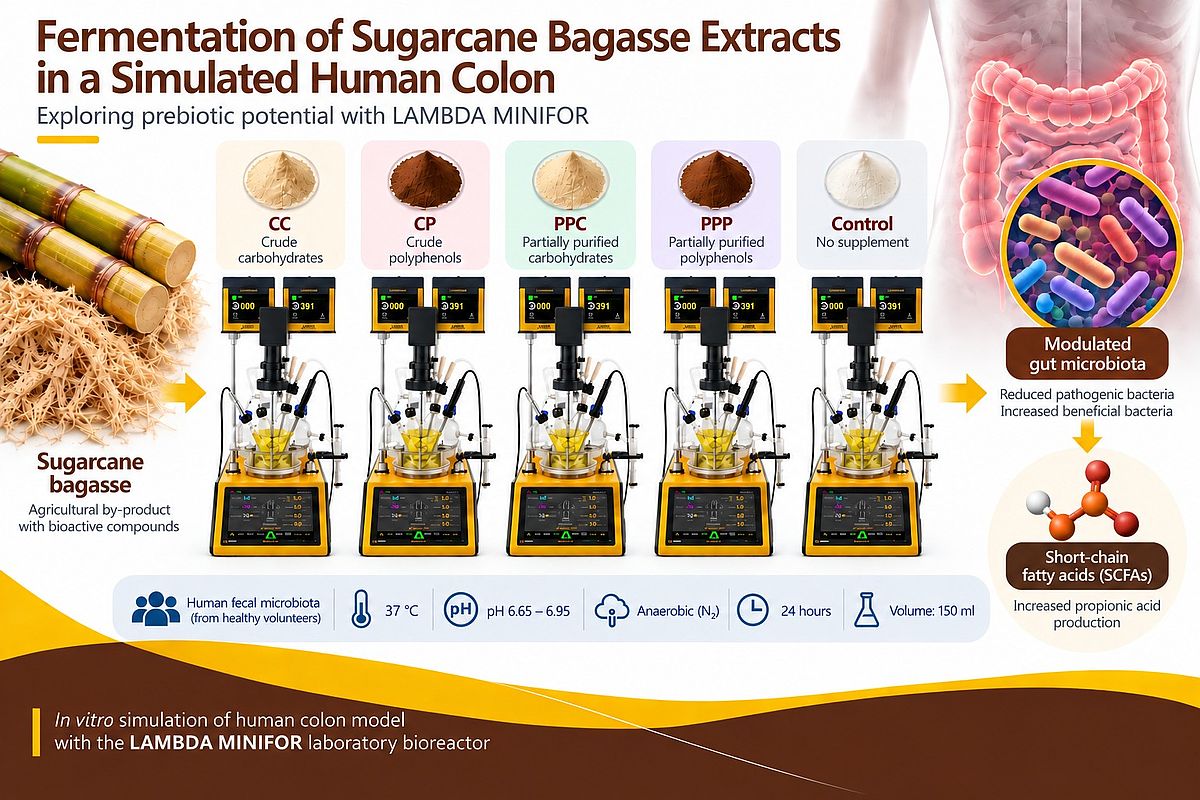
The researchers evaluated four fractions: crude carbohydrates (CC), crude polyphenols (CP), partially purified carbohydrates (PPC), and partially purified polyphenols (PPP). The fermentation was performed using a LAMBDA Minifor laboratory bioreactor as the in vitro human gut model, with conditions designed to simulate fermentation in the descending colon.
LAMBDA Minifor as a simulated-colon fermentation system
The experimental objective was to expose a complex human fecal microbial community to defined sugarcane bagasse fractions under controlled conditions. Unlike a conventional microbial culture, this type of gut model involves a mixed community whose composition and metabolic activity can change during fermentation.
The LAMBDA Minifor provided the controlled bioreactor environment for this experiment. Fermentation was maintained at 37 °C under anaerobic conditions, with pH controlled within the range selected for the simulated descending colon, over a 24-hour fermentation period. Samples collected during the experiment were subsequently analyzed for microbial composition and fermentation metabolites.
This makes the Minifor relevant not simply as a culture vessel, but as a laboratory bioreactor for controlled in vitro gut fermentation, where temperature, pH and anaerobic conditions need to remain reproducible.
Reference: Pongsuwanporn, T., Arunmas, E., Tunsagool, P., Chitprasert, P., & Nakphaichit, M. (2026). Exploring the effects of sugarcane bagasse extracts on human gut microbiota via fecal batch fermentation. Journal of Food Science and Technology, 63, 1311–1322. doi.org/10.1007/s13197-025-06284-1
How did the sugarcane bagasse extracts affect the microbiome?
The study found that the response depended strongly on the extract fraction.
Crude polyphenols (CP) showed the strongest microbiota-modulating effect. CP increased species richness and produced the greatest reduction in Enterobacteriaceae, while stimulating several bacterial families associated by the authors with beneficial gut microbiota, including Peptostreptococcaceae, Lachnospiraceae, Ruminococcaceae and Bacteroidaceae.
Partially purified carbohydrates (PPC) produced a different microbial response, decreasing Peptostreptococcaceae while increasing Porphyromonadaceae. PPC also tended to promote propionic acid production compared with the control and produced significantly more propionic acid than the PPP treatment.
Based on these findings, the authors identified CP and PPC as potential candidates for prebiotic applications. The results should, however, be interpreted as in vitro evidence rather than evidence of a demonstrated health effect in humans.
From agricultural by-product to microbiome research
The study illustrates an increasingly relevant bioprocessing approach: using controlled fermentation to evaluate how compounds recovered from agricultural residues interact with complex microbial communities.
The workflow can be summarized as:
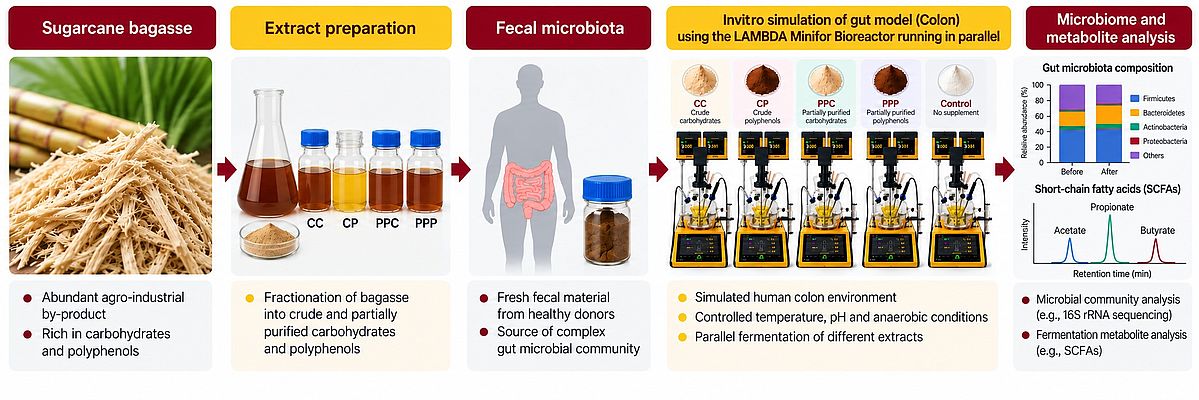
For researchers working on in vitro gut models, prebiotic screening, plant-derived functional ingredients, or microbiome–substrate interactions, the study demonstrates a practical application of a laboratory bioreactor for maintaining defined fermentation conditions while the biological response is investigated.
Conclusion
The work by Pongsuwanporn et al. demonstrates the use of LAMBDA Minifor as an in vitro human gut model for studying sugarcane bagasse extracts under simulated descending-colon fermentation conditions. The study found that CP and PPC had distinct effects on the gut microbiota, with CP showing pronounced microbiota modulation and PPC influencing propionic acid production.
For biotechnology researchers, the study is a useful example of how a controlled laboratory bioreactor can support microbiome fermentation studies and early-stage evaluation of potential prebiotic substrates.