Hypoxic Cell Culture with the LAMBDA Minifor2Bio touch Bioreactor
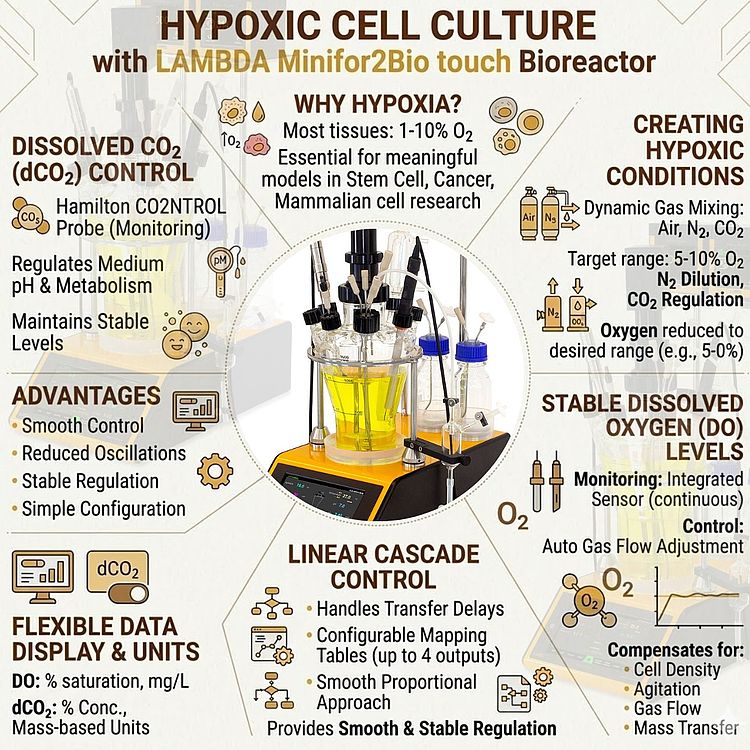
Many cells grow at oxygen levels far below atmospheric air. While incubators operate at ~21% O₂, most tissues experience 1–10% O₂, making hypoxic conditions essential for relevant results in stem cell, cancer, and mammalian cell research. The LAMBDA Minifor2Bio touch Bioreactor enables stable hypoxic culture through controlled gas mixing, dissolved oxygen monitoring, and cascade control, while also supporting dissolved CO₂ regulation.
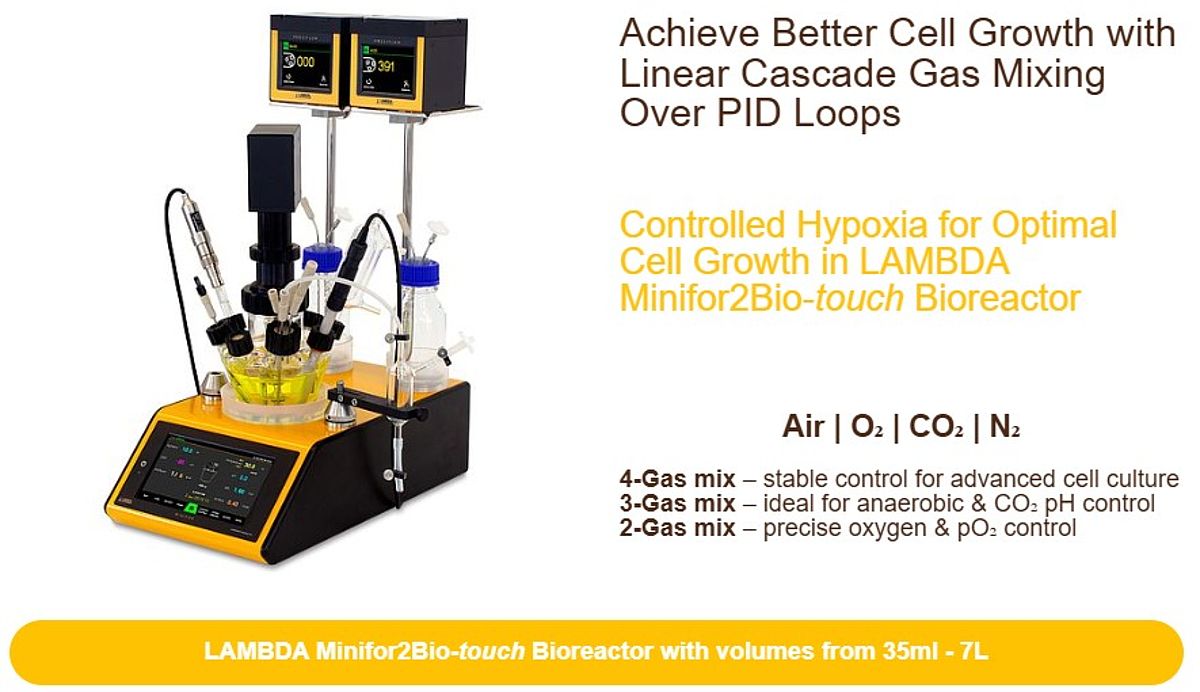
The LAMBDA Minifor2Bio touch Bioreactor allows researchers to generate controlled oxygen environments by adjusting the composition of the inlet gas mixture.
Typical Gas Configuration
A typical setup for hypoxic cultivation may include:
-
An integrated air mass flow controller
-
An external nitrogen controller for oxygen dilution
-
An optional CO₂ controller for carbon dioxide regulation
By adjusting the ratio of air and nitrogen, oxygen levels inside the reactor can be reduced to the desired range. For many applications this may be between 5% and 10% oxygen, although other levels can also be maintained depending on the experimental requirements.
Because the gas composition can be controlled dynamically, oxygen levels remain stable even when cellular oxygen consumption changes during cultivation.
Maintaining Stable Dissolved Oxygen Levels
During cell growth, oxygen demand often changes as the culture develops. If oxygen supply remains constant, dissolved oxygen levels may decrease as cell density increases.
The LAMBDA Minifor2Bio touch Bioreactor continuously measures dissolved oxygen using an integrated sensor. When oxygen levels begin to change, the control system automatically adjusts gas flows to maintain the target conditions.
Factors Affecting Oxygen Transfer
Several parameters influence oxygen transfer in a bioreactor:
-
Cell density and metabolic activity
-
Agitation speed and mixing efficiency
-
Gas flow rate and bubble formation
-
Gas–liquid mass transfer properties
The control system compensates for these factors in real time, helping maintain consistent oxygen levels throughout the cultivation process.
Dissolved CO₂ Control in Cell Culture
In many cell culture systems, carbon dioxide plays an important role in maintaining culture stability. Dissolved CO₂ can influence medium pH, cellular metabolism, and overall culture performance.
The LAMBDA Minifor2Bio touch Bioreactor supports monitoring of dissolved CO₂ using sensors such as the Hamilton CO2NTROL probe. The measured CO₂ concentration can then be used as a control signal to regulate CO₂ gas flow.
This approach allows researchers to maintain stable dissolved CO₂ levels while simultaneously controlling oxygen concentration within the culture.
Understanding Cascade Control in the LAMBDA Minifor2Bio touch Bioreactor
Precise gas control in a bioreactor is not always straightforward. Gas transfer between the gas phase and the liquid culture medium introduces delays, which can make conventional control strategies difficult to tune.
The LAMBDA Minifor2Bio touch Bioreactor uses a cascade control concept designed to handle these challenges.
How Cascade Control Works
In cascade control, one measured parameter is used to regulate another process variable.
For example:
-
A dissolved CO₂ measurement can regulate the CO₂ gas flow entering the reactor
Users define a mapping table that links the measured parameter (source) to one or more control parameters. Up to four control outputs can be assigned to a single measurement.
The system then adjusts the control outputs dynamically based on this mapping.
Linear Control for Stable Gas Regulation
Instead of relying on traditional PID control loops, the LAMBDA Minifor2Bio touch Bioreactor uses a linear proportional control approach.
Users define several reference points in the mapping table, and the controller performs linear interpolation between these points to determine the correct control response.
Advantages of Linear Cascade Control
This approach provides several practical benefits:
-
Smooth control behavior
-
Reduced oscillations in dissolved gas levels
-
Stable regulation in gas–liquid systems
-
Simple configuration for researchers
Because gas transfer processes often respond slowly, gradual proportional adjustments often provide more stable results than aggressive PID corrections.
Example: CO₂ Gas Flow in a Small-Scale Culture
Consider a reactor with a 300 mL working volume.
If the aeration rate is 0.1 VVM, the total gas flow entering the reactor is approximately 30 mL per minute.
If the inlet gas mixture contains 5% CO₂, the theoretical CO₂ flow would be approximately 1.5 mL per minute.
However, the actual dissolved CO₂ concentration inside the culture depends on several additional factors, including agitation speed, gas transfer efficiency, and cellular metabolic CO₂ production.
With cascade control enabled, the LAMBDA Minifor2Bio touch Bioreactor automatically adjusts CO₂ flow rates to maintain the desired dissolved CO₂ level instead of operating at a constant flow rate.
Flexible Data Display and Measurement Units
The reactor interface allows sensor measurements to be displayed in different units depending on the experimental requirements.
Dissolved Oxygen Display Options
Dissolved oxygen measurements can be displayed as:
-
Percent saturation
-
mg/L
Dissolved CO₂ Measurement Units
Dissolved CO₂ values can be displayed in different formats such as:
-
Percent concentration
-
Mass-based units
This flexibility allows researchers to interpret process data using the units most appropriate for their applications.
A Practical Platform for Hypoxic Cell Culture Research
Hypoxic cell culture is becoming increasingly important in many areas of biotechnology and life sciences. Reproducing physiological oxygen levels helps researchers better understand how cells behave in their natural environments.
With flexible gas control, stable cascade regulation, and precise sensor integration, the LAMBDA Minifor2Bio touch Bioreactor provides a reliable platform for cultivating cells under controlled hypoxic conditions while maintaining accurate regulation of dissolved gases. Stable Hypoxic Culture Enabled by Cascade Control
Ready to achieve stable hypoxic control in your cell culture?
Contact us to learn more about the LAMBDA Minifor2Bio touch Bioreactor. Email us at sales@lambda-instruments.com