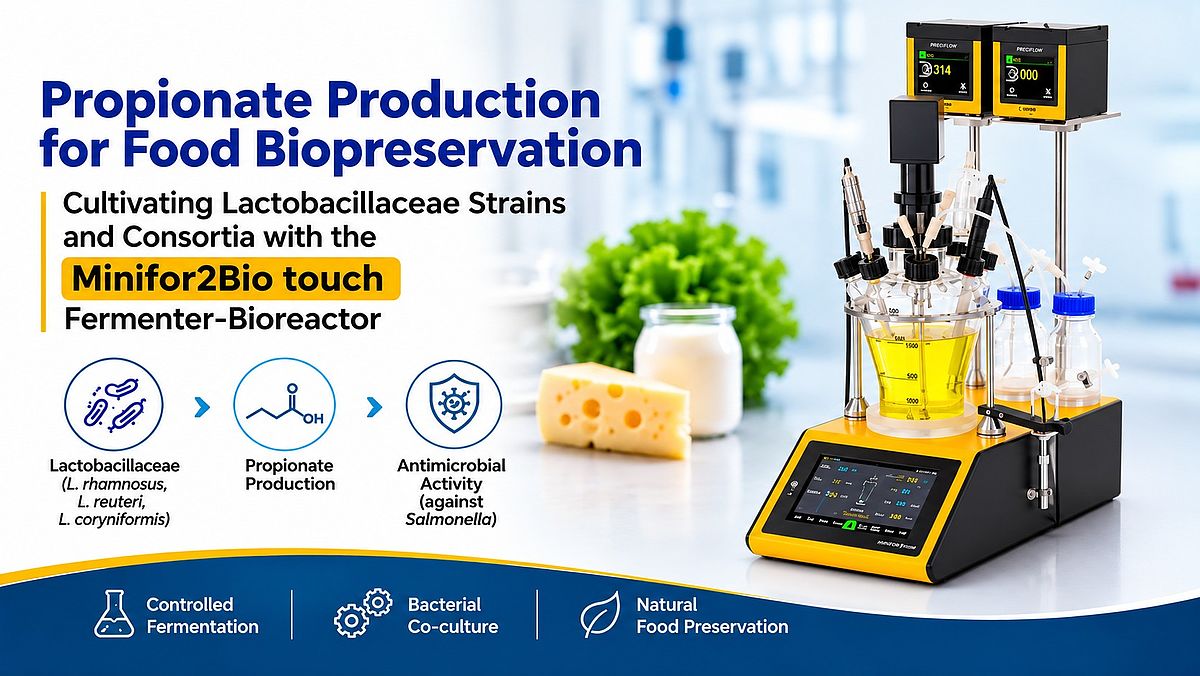
Propionate Production Using Lactobacillaceae: Food Biopreservation Research with the LAMBDA Minifor Fermenter
Food biopreservation is an important area of research focused on extending food shelf life and controlling unwanted microorganisms through beneficial bacteria and their metabolic products.
In a 2024 study, researchers from Aarhus University, Denmark, investigated how selected Lactobacillaceae strains could produce propionate, a short-chain carboxylic acid with antimicrobial properties. The research explored individual bacterial strains and carefully designed microbial consortia to develop propionate-containing fermentates with potential applications in natural food preservation.
The study investigated three bacterial species: Lacticaseibacillus rhamnosus, Limosilactobacillus reuteri and Loigolactobacillus coryniformis.
SCIENTIFIC REFERENCE: Buljubašić, E., Bambace, M. F., Christensen, M. H. L., Ng, K.-S., Huertas-Díaz, L., Sundekilde, U., Marietou, A. & Schwab, C. (2024). Novel Lactobacillaceae strains and consortia to produce propionate-containing fermentates as biopreservatives. Microbial Biotechnology, 17(2), e14392.
HOW THE LAMBDA MINIFOR FERMENTER WAS USED
The researchers used the LAMBDA Minifor laboratory fermenter to cultivate selected Lactobacillaceae strains and bacterial consortia under controlled anaerobic conditions.
The experimental setup supported batch fermentation of two-strain consortia combining L. rhamnosus and L. reuteri, as well as fed-batch cultivation of L. coryniformis.
Important cultivation parameters, including temperature and pH, were controlled during the experiments. LAMBDA SIAM software was used for process control, while peristaltic pumps supported automated pH adjustment.
Rhamnose was used as the carbohydrate substrate in all bioreactor cultivation experiments.
This setup enabled the researchers to investigate bacterial growth, substrate utilisation and the production of short-chain carboxylic acids, particularly propionate.
Key advantages of the LAMBDA Minifor for this application:
- Controlled fermentation conditions for microbial cultivation.
- Suitable for both batch and fed-batch fermentation.
- Automated pH adjustment using peristaltic pumps.
- Process monitoring and control through SIAM software.
- Compact laboratory-scale configuration for microbial process development.
Discover more about the LAMBDA Minior2Bio touch fermenter-bioreactor and its capabilities for microbial cultivation and fermentation research.
KEY RESEARCH FINDINGS
The study demonstrated that selected Lactobacillaceae strains and bacterial combinations could produce propionate through different metabolic pathways.
The two-strain consortia of L. rhamnosus and L. reuteri produced propionate through a metabolic cross-feeding mechanism. In this process, L. rhamnosus contributed to the production of 1,2-propanediol, which could subsequently be utilised by L. reuteri for propionate formation.
The researchers also demonstrated direct propionate formation from rhamnose by L. coryniformis DSM 20001. This finding expanded the understanding of the metabolic capabilities of this bacterial strain.
The resulting fermentates contained mixtures of short-chain carboxylic acids, primarily lactate and acetate, together with propionate.
ANTIMICROBIAL POTENTIAL OF PROPIONATE-CONTAINING FERMENTATES
An important part of the research was investigating the antimicrobial activity of the resulting acid mixtures against Salmonella enterica.
The results showed that propionate significantly enhanced antimicrobial activity in two of the three synthetic mixtures tested. However, the antimicrobial effect depended on the bacterial combination and the overall acid composition.
Interestingly, the DSM 20016-based synthetic mixture demonstrated the strongest overall antimicrobial activity, even without additional propionate.
One of the actual fermentates was also tested directly and demonstrated 50% inhibition at a 5.5-fold dilution.
These findings highlight the potential of propionate-containing fermentates as ingredients for developing natural food biopreservation strategies. Further optimisation and validation in actual food systems will be necessary to establish their practical applications.
CONCLUSION
This research demonstrates how controlled laboratory fermentation can support the development of microbial processes for producing valuable organic acids with potential applications in food preservation.
Using the LAMBDA Minifor fermenter, the researchers cultivated selected Lactobacillaceae strains and microbial consortia under controlled conditions and investigated their ability to produce propionate-containing fermentates.
The study highlights the importance of laboratory bioreactors in microbial cultivation, bacterial co-culture research, fermentation process development and the investigation of innovative food biopreservation approaches.
The LAMBDA Minifor provides a compact and versatile platform for researchers working on microbial fermentation, metabolic studies and the development of new biotechnological processes.
LOOKING FOR A LABORATORY BIOREACTOR FOR MICROBIAL CULTIVATION?
The LAMBDA Minifor fermenter-bioreactor is a compact laboratory system designed for controlled microbial cultivation and small-scale fermentation process development.
Its optimized vessel design supports flexible laboratory-scale fermentation configurations. Learn more about the LAMBDA Minifor optimized vessel design.
With its integrated temperature and pH control capabilities, flexible cultivation configurations and compatibility with LAMBDA SIAM software, it supports a wide range of microbial and fermentation research applications.
Explore the LAMBDA Minifor fermenter-bioreactor and discover its capabilities for your research.