Parallel Multi Column Purification Using LAMBDA OMNICOLL Multichannel Fraction Collector
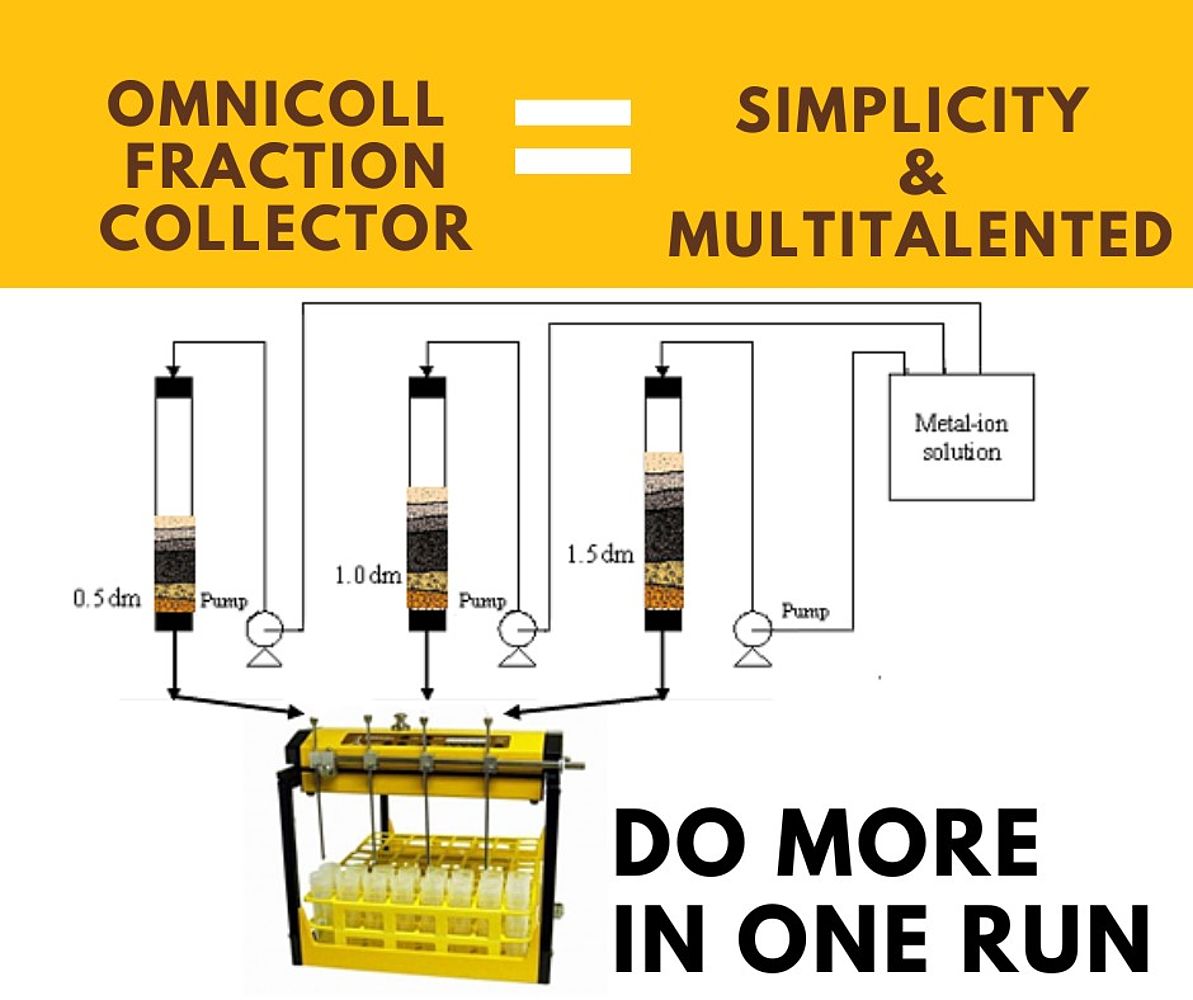
The LAMBDA OMNICOLL multichannel fraction collector enables parallel multiple column purification, allowing simultaneous operation and fraction collection from multiple chromatography or ion-exchange columns within a single system. With LAMBDA multichannel accessories, different solvents, solutes, and column types can be processed in parallel, significantly reducing experimental time while ensuring precise, automated, and reproducible fraction collection.
Flexible Sample Collection Programming
The OMNICOLL control unit allows precise timing control for fraction collection, supporting:
- Time intervals from 0.1 to 999.9 minutes (0.1 min steps)
- Time intervals from 1 to 9999 minutes (1 min steps)
- Regular sampling intervals (e.g., every 'n' minutes)
- Repeated collection cycles (e.g., 'n' number of samples for every 'n' number of minutes)
- For advanced workflows requiring non-uniform or custom time windows, the SIAM software enables fully programmable fraction collection profiles tailored to specific experimental requirements.
Waste Diversion Control
Fractions from sorption or chromatography columns can be efficiently managed using the OMNICOLL system. By integrating a 3-way valve, the flow can be diverted to waste when fractions are not being collected and redirected to collection vessels during defined sampling periods. For multichannel operation, each channel requires an individual valve (e.g., 6 channels require 6 valves). While valves are not supplied by LAMBDA, they can be easily sourced from standard suppliers.
To support automated operation, LAMBDA supplies a valve control module with either 12V or 24V power output, enabling precise opening and closing of valves in synchronization with fraction collection.
Multichannel Pump Integration
Use third-party multichannel pumps or LAMBDA pumps to supply multiple columns simultaneously with adsorption, purification, or elution solutions. Achieve uniform flow distribution and efficient parallel processing.
High-Throughput Fraction Collection
This multiple column fraction collection system ensures consistent sampling across all channels, enabling accurate monitoring of adsorption, breakthrough, and desorption processes. By increasing throughput and simplifying complex workflows, the OMNICOLL is ideal for high-throughput chromatography, ion-exchange studies, and advanced separation application.
Remote Control
Supports external voltage triggering (3–12 V or 12–30 V with resistor) for automated fraction collection in Normal and High modes.
Optional RS-232 interface and non-volatile memory enable reliable remote operation and storage of all settings.
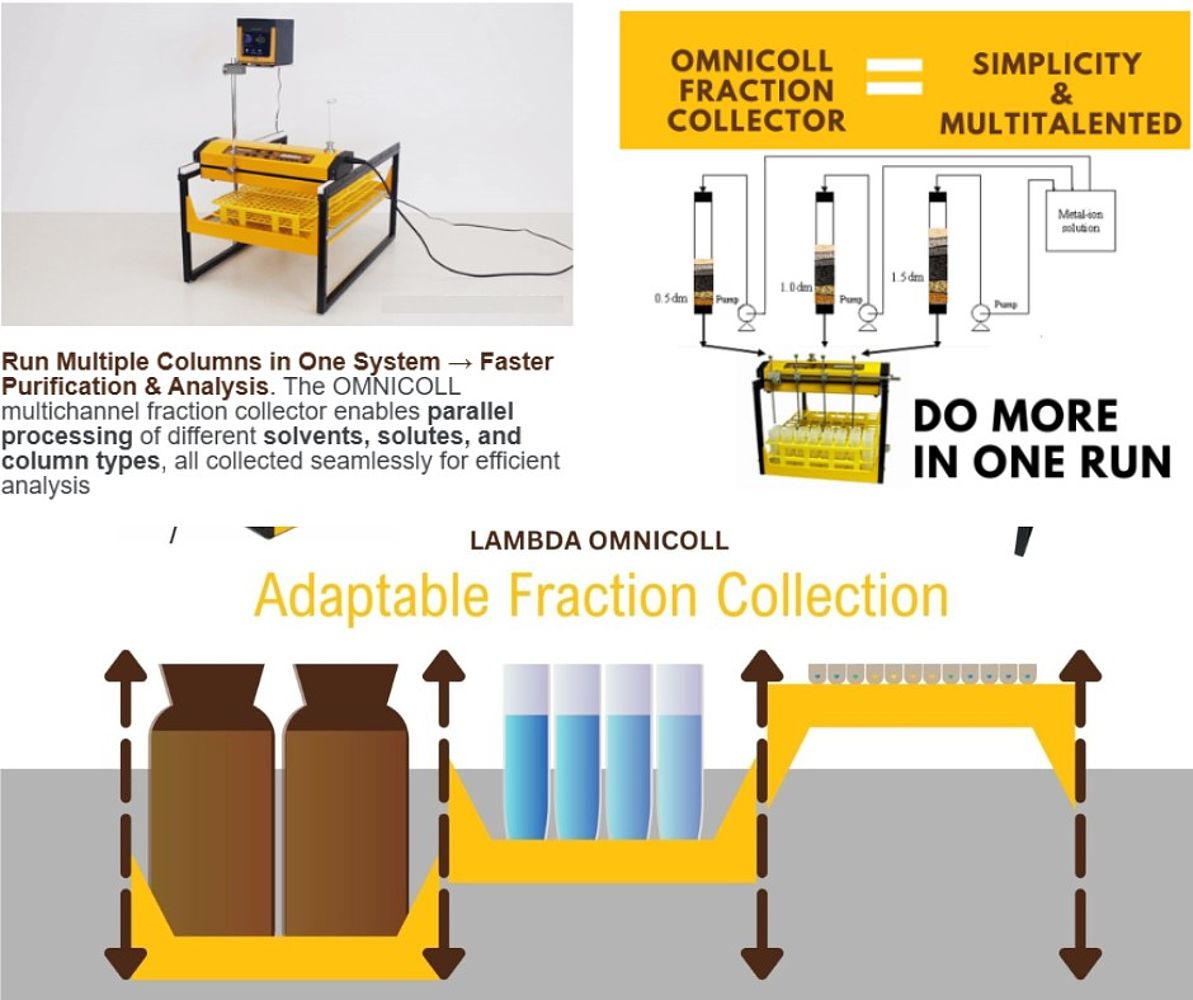
Recipients - From microwell plates to larger bottles
Compatible with any tube rack or container within 45 × 31 cm, supporting a wide range of tube sizes.
Our Standard configurations include 360 tubes (12–13 mm), 240 tubes (16 mm), 160 tubes (20 mm), and 96 tubes (30 mm), with capacity expandable by coupling additional collector units.
Automated Fraction Collection in Ion Exchange and Separation Research Using the LAMBDA OMNICOLL
Scientific References
Dinu, M. V. et al. (2022). Aminopolycarboxylic acids-functionalized chitosan-based composite cryogels as sorbents: Fixed-bed column studies.
Choudhary, A. et al. (2023). Influence of iron oxide minerals on nanoplastics transport in aqueous environments. Science of The Total Environment.
doi.org/10.1016/j.scitotenv.2023.169132Cazals, F. et al. (2022). Remobilization of polycyclic aromatic hydrocarbons from contaminated porous media. Journal of Contaminant Hydrology, 251, 104065.
doi.org/10.1016/j.jconhyd.2022.104065Chubar, N. & Szlachta, M. (2015). Adsorptive removal of selenite and selenate using layered double hydroxides. Chemical Engineering Journal, 279, 885–896.
doi.org/10.1016/j.cej.2015.05.070Lu, J. et al. (2014). Migration of inorganic cations in soil using ion-exchange column studies. Applied Geochemistry, 41, 151–162.
doi.org/10.1016/j.apgeochem.2013.12.009Velimirovic, M. et al. (2016). Zerovalent iron particles for groundwater remediation. Science of The Total Environment.
doi.org/10.1016/j.scitotenv.2015.11.007