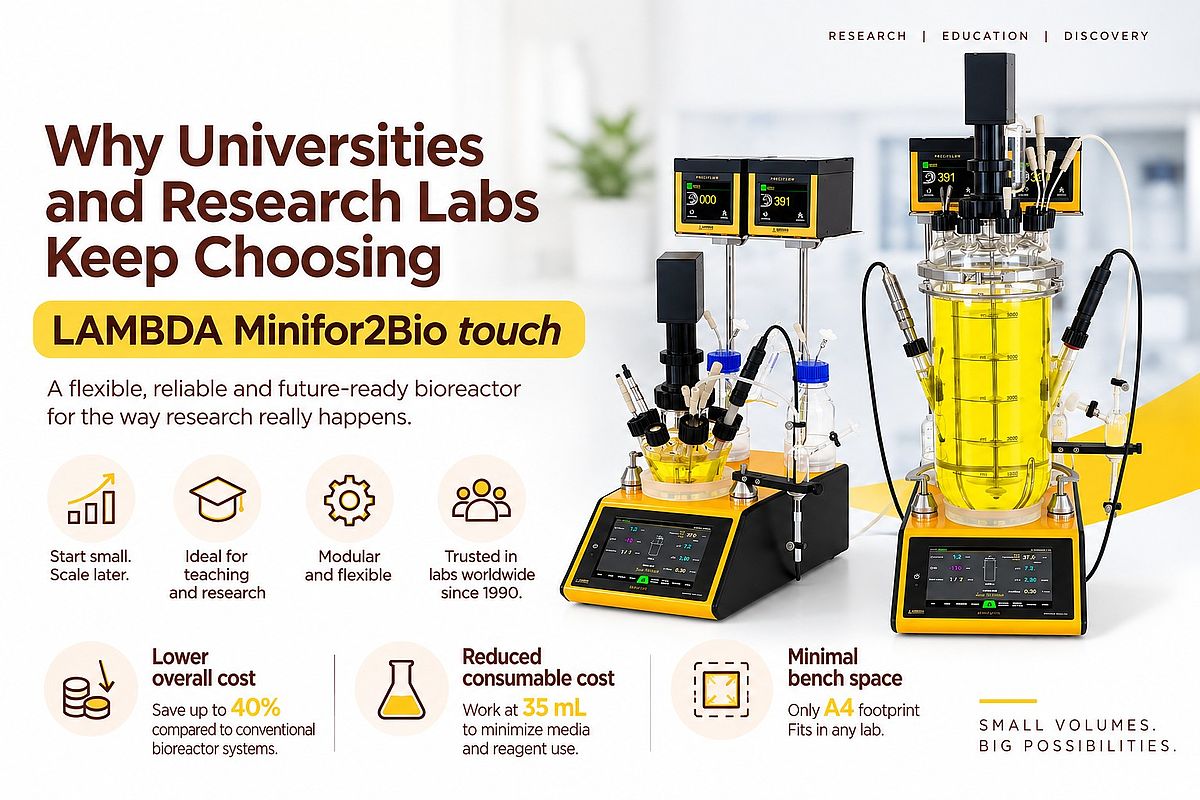
Why Universities and Research Labs Keep Choosing the LAMBDA Minifor2Bio touch Fermenter-Bioreactor
LAMBDA has been supplying the Minifor bench-top fermenter and bioreactor since 1990. The platform's design also received an innovation award in 2007. After more than three decades in universities and research laboratories, one thing is clear: LAMBDA Minifor2Bio touch continues to fit particularly well with the way academic research is actually carried out.
Research projects change. Budgets change. Students come and go. A system that works well in this environment needs to be flexible, easy to use and practical to maintain. These are some of the reasons the Minifor platform has remained relevant in research laboratories for so long.
Research Runs on Changing Budgets and Changing Plans
At the beginning of a grant, a principal investigator does not always know exactly where a project will end up. An experiment may start at a relatively small volume simply to establish whether an idea works. If the results are encouraging, the work may later move to 1 L or beyond.
The same applies to the people using the equipment. In a university laboratory, students may join for a master's project, PhD, postdoctoral work or a short research placement. They need to become comfortable with the equipment without spending weeks learning a complicated control system.
This is where a small, modular bioreactor can make a real difference.
Grow the System as the Research Grows
One of the main strengths of LAMBDA Minifor2Bio touch is its modular design. The same unit can be used with different vessel sizes, rather than requiring a completely new bioreactor when the required working volume changes.
Alongside the standard 1 L vessel, LAMBDA offers 0.3 L, 0.4 L, 3 L and 7 L vessels. The 0.3 L vessel can be operated with a minimum working volume of just 35 mL.
For a research laboratory, this means the initial investment can be matched to the project rather than to a possible future requirement. A laboratory can start with the vessel it needs and add other sizes later as the research develops.
The modular approach also extends beyond the vessels. Pumps, integrators, mass-flow gas controllers and software can be added when they become useful. Some of these components can also be used independently for other laboratory work.
That is useful in academic research because equipment does not always stay dedicated to one project for its entire lifetime.
A Practical Choice for Teaching Laboratories
Equipment used for teaching has to cope with a different environment from equipment used by one experienced process engineer. Several students may use the same system during a day, and the next group may have little or no previous experience with it.
Sterilization is a good example. The vessels can be sterilized in standard laboratory autoclaves, so there is no need for a dedicated in-place sterilization system. This keeps the overall workflow straightforward and avoids introducing unnecessary complexity into student practicals.
The physical size of the equipment also matters. A LAMBDA Minifor2Bio touch unit occupies roughly the area of an A4 sheet of paper and is light enough to be moved by one person. The side necks used for probes and connections are positioned at a 30° angle, making the ports easy to reach.
This may seem like a small design detail, but it is useful when students are learning aseptic techniques. Having the connections clearly accessible makes it easier to demonstrate the procedure and for students to repeat it themselves.
Maintenance is another consideration. The system uses heavy-duty silicone membranes and multipoint sealing rather than relying on conventional O-rings. The peristaltic pumps are designed to work with silicone tubing and provide consistent dosing during operation.
For a teaching laboratory, where the equipment may be used repeatedly by different groups, simple maintenance and quick turnaround are important practical advantages.
Each Unit Can Work Independently
LAMBDA Minifor2Bio touch does not depend on a central controller to operate several units. Each unit has its own console, where users can see the actual and set values, process parameters and alarm conditions.
This is convenient when several experiments are running at the same time. The units do not have to be installed next to each other simply because they share a control system. They can be placed where they are most useful in the laboratory.
There is also the option to connect several units to a single PC. With the appropriate software, researchers can control the units remotely and collect and process data centrally.
This gives a laboratory two options. Each bioreactor can be used as a self-contained system, or several units can be brought together when a larger coordinated setup is required.
For departments with several research groups, this can be a useful arrangement. A unit can remain available to an individual group while still being part of a wider laboratory setup when needed.
What Does This Mean for a Grant-Funded Laboratory?
For many university laboratories, purchasing a bioreactor is not simply a question of finding the most advanced system available. The equipment also has to fit within the grant budget.
A laboratory may need only a small working volume initially. Spending a large amount on a system designed for a future requirement that may never materialize is not always the best use of research funding.
The LAMBDA Minifor2Bio touch base system, including the controller and a vessel configuration suitable for working at 35 mL, is priced at approximately $20,000. Additional vessel configurations can then be added as the required cultivation volume increases.
| Vessel configuration | Cumulative cost |
|---|---|
| 35 mL-capable base system | $20,000 |
| + 0.4 L vessel | $22,000 |
| + 1 L vessel | $24,000 |
| + 3 L vessel | $26,000 |
| + 7 L vessel | $28,000 |
For comparison, conventional reusable single-vessel bioreactor systems can have a considerably higher initial cost. Depending on the manufacturer and configuration, a system with a small vessel may cost around $35,000–$45,000, with larger vessel configurations and additional equipment adding several thousand dollars more.
Using these indicative figures, a laboratory following a similar expansion path through 1 L and a larger vessel could spend approximately $41,000–$61,000. The corresponding LAMBDA Minifor2Bio touch configurations shown above would total approximately $24,000.
For a laboratory working with a fixed grant budget, the difference can be significant. More importantly, the laboratory does not have to purchase the largest configuration on day one. It can start with a smaller vessel and expand the same system when the research justifies it.
The figures above are indicative estimates based on published information and market pricing for conventional reusable systems, rather than confirmed vendor quotations. Actual prices depend on the manufacturer, vessel configuration, sensors, automation, accessories and procurement conditions. Current quotations should be obtained before making a purchasing decision.
Why Working at a Smaller Volume Can Matter
Working volume is not only an equipment decision. It can also have a direct effect on the cost of running experiments.
In many research projects, the bioreactor itself is purchased once, while media, growth factors, supplements and other cultivation materials are consumed every time an experiment is run. For some applications, these consumables can become a substantial part of the project cost.
This is especially relevant when working with expensive media, growth factors or limited biological material.
If an experiment can answer the research question at 35 mL rather than 1 L, there is little reason to use the larger volume simply because the equipment is capable of it. Using a smaller working volume reduces the amount of medium and other materials required for each run.
The LAMBDA Minifor2Bio touch 0.3 L vessel has a minimum working volume of 35 mL, making this small-scale work practical while keeping the same platform available for larger volumes later.
For screening experiments, early-stage process development or experiments where material is limited, this can be particularly useful. Researchers can first establish whether an experimental condition is worth pursuing and then increase the volume when there is a scientific reason to do so.
In other words, scale can follow the research rather than the other way around.
Warranty and Support
LAMBDA Minifor2Bio touch units are supplied with a 2-year warranty. The Preciflow touch peristaltic pumps have an extended 5-year warranty.
For a university laboratory, long-term support and the availability of replacement components are also important considerations. Research equipment may remain in service across several projects and several generations of students, so durability and maintainability matter well beyond the initial purchase.
The Scale That Makes Sense for Academic Research
LAMBDA Minifor2Bio touch is a laboratory-scale bioreactor platform, covering cultivation volumes from 35 mL up to 7 L. It is not intended to replace pilot- or production-scale bioprocessing equipment. Those systems serve a different purpose and come with different requirements.
For academic research, however, much of the early work happens at laboratory scale. This includes strain and clone screening, microbial cultivation, cell culture studies, stem cell research, cancer research, microbiome studies and student research projects.
This is the space in which the Minifor platform has been developed for more than 30 years.
The main advantage is not simply that one unit can accommodate different vessel sizes. It is that the laboratory can change the way it uses the system as the research changes.
A project can start at 35 mL, move to 0.4 L or 1 L when the results justify it, and continue to larger volumes when required. The same core unit remains in the laboratory throughout.
For universities and research institutes working with changing projects, changing budgets and changing users, that kind of flexibility can be more valuable than simply having the largest bioreactor available from the beginning.
To discuss the right configuration for your laboratory or department, contact LAMBDA at support@lambda-instruments.com | +420 603 970 653