LAMBDA DOSER touch
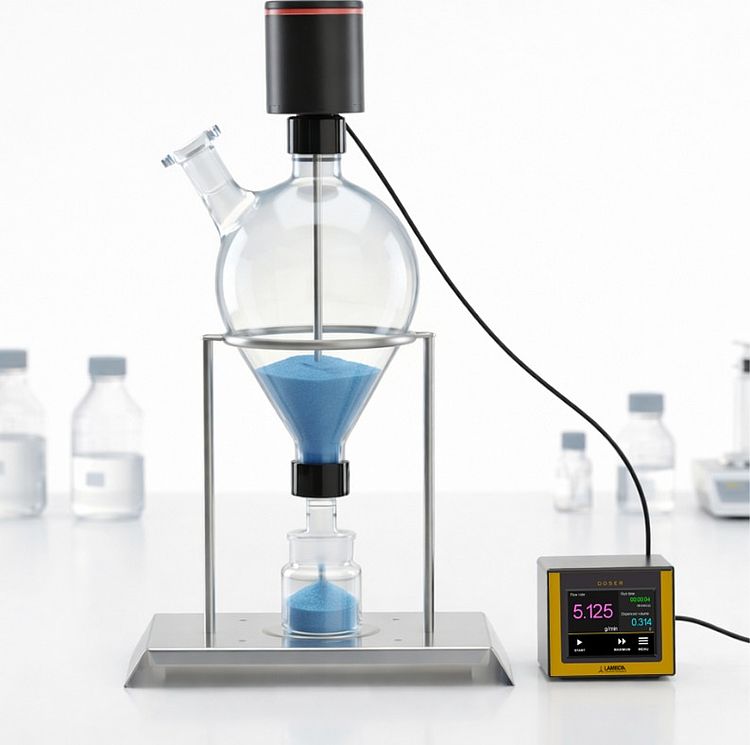
LAMBDA DOSER touch
Precision automated powder feeder and doser for laboratory and process applications. Flow range from 10 mg/min to 250 g/min (NaCl). DOSER touch offers Efficient, Automated & Cost-Effective Powder Dispensing
LAMBDA DOSER touch - Automated Programmable Powder Feeder/Doser
The LAMBDA DOSER touch powder feeder is an advanced, programmable powder doser designed for accurate continuous or intermittent dispensing of free-flowing solid substances such as powders, crystalline materials, and fine granular solids.
This automated powder dispenser enables continuous feeding or portion-wise dosing with programmable pauses, eliminating manual spoon dosing and ensuring high reproducibility in laboratory and pilot-scale environments.
High-Precision Powder Dosing Technology
At the core of this high-performance powder dosing system is a quartz-controlled motor, based on the same precision technology used in electronic timekeeping.
Unlike conventional screw-based powder feeders that may compact or clog powders, the LAMBDA powder doser employs an open spiral-type powder distributor.
The spiral gently transports powder toward the center of the dosing unit, where it falls freely from the outlet, ensuring smooth, clog-free, and highly consistent powder dispensing
Powder Dispensing Range & Performance
Powder dispensing range: ~ 5 mg/min to 250 g/min (based on NaCl under ideal laboratory conditions)
The DOSER touch powder doser with a standard distributor provides a dosing range of 50 mg/min to 250 g/min.
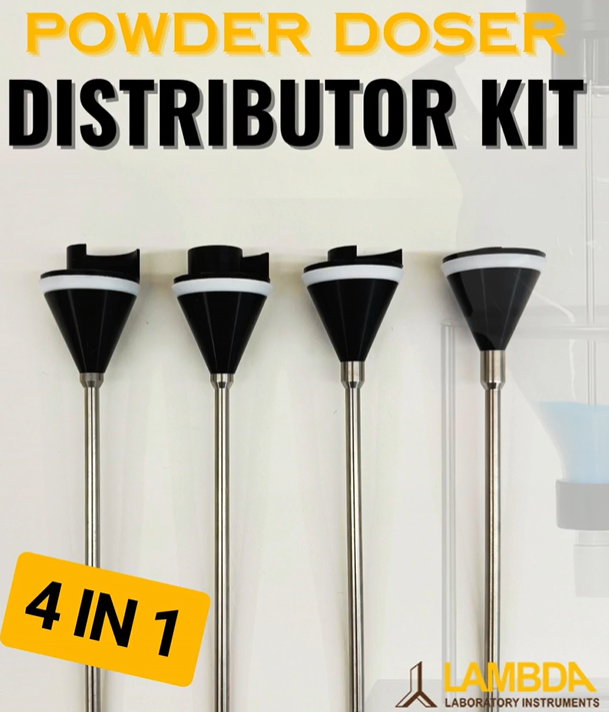
Modular Distributor Kits for Adjustable Powder Feeding Rates
- Standard distributor (default): 50 mg/min – 250 g/min
- Standard distributor for very free-flowing powders: 50 mg/min – 250 g/min
- Standard distributor (2× reduced speed): 25 mg/min – 125 g/min
- Standard distributor (10× reduced speed): approx. 5 mg/min – 25 g/min
Note: Flow rates are based on NaCl at our lab condition
Powder Feeder Vessel Sizes & Controlled Atmosphere Dosing
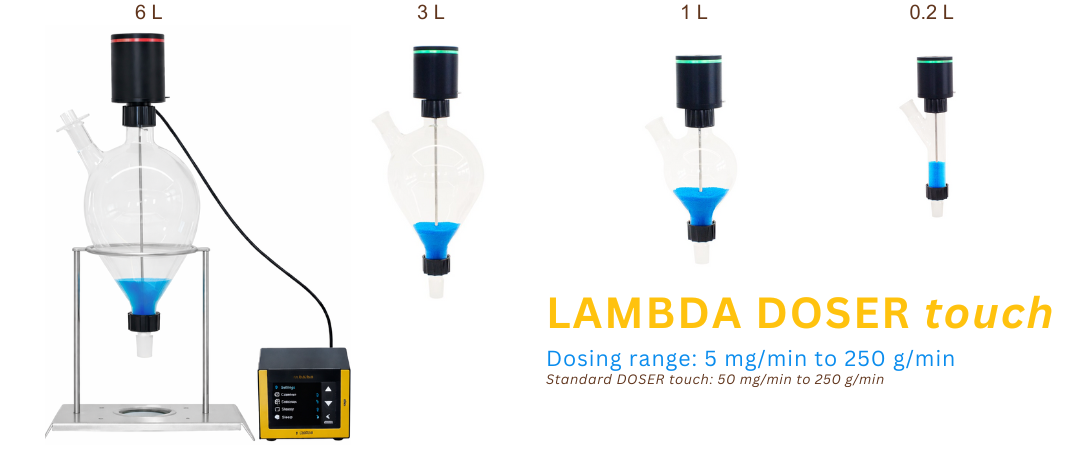
The DOSER touch powder dispenser is available with standard glass vessels of 0.2L, 1L, 3L and 6L
Art no: A5814-0.2L - DOSER touch powder doser, programmable (capacity approx. 0.2 l)
Art no: A5814-1L - DOSER touch powder doser, programmable (capacity approx. 1 l)
Art no: A5814-3L - DOSER touch powder doser, programmable (capacity approx. 3 l)
Art no: A5814-6L - DOSER touch powder doser, programmable (capacity approx. 6.5 l), siliconized vessel
For continuous powder feeding, larger vessels include a side refill neck, allowing uninterrupted dosing during operation.
Powder dosing can be performed under controlled atmospheres by purging inert gases such as N₂ or Ar, making the system suitable for oxygen-sensitive or hygroscopic powders.
Integration of Powder Feeder with Laboratory & Reactor Systems
Using standard glass adapters, the DOSER touch powder doser integrates easily with laboratory glassware via NS 29/32 ground joints or SVL threaded connectors.
The compact footprint of this laboratory powder feeder allows seamless installation even in space-restricted or complex reactor configurations.
Robust construction and chemically resistant materials ensure long-term reliability in laboratory and pilot-scale setups.
Efficient, Automated & Cost-Effective Powder Dispensing
Automated portion-wise powder dispensing reduces manual handling and allows laboratory personnel to focus on high-value research activities.
Improved dosing reproducibility minimizes experimental variability and reduces the need for repeat experiments—saving time and resources.
With reliable performance and competitive pricing, the DOSER touch powder feeder offers an excellent price-to-performance ratio.
Safe, Airtight & Compliant Powder Dosing System
The LAMBDA DOSER touch powder dispenser is engineered to meet modern laboratory safety standards, enabling safe and reproducible dosing of hazardous or reactive powders.
The hermetically sealed construction minimizes operator exposure and ensures secure handling of toxic substances.
Remote operation enables powder dosing while maintaining a safe distance for laboratory personnel.
Multiple sealing points ensure an airtight powder dosing system, suitable for operation under slight vacuum or overpressure.
The integrated gassing plug allows purging with inert gas or dry air, protecting moisture-sensitive powders from clumping or degradation.
Optional glass vessels with a silicone safety coating reduce breakage risk. All powder-contact materials are chemically resistant for long-term durability.
Whether in scale-up, or production environments, the LAMBDA DOSER touch sets a new standard in automated powder dosing - combining Swiss precision, versatile functionality, and advanced safety features in one compact instrument.
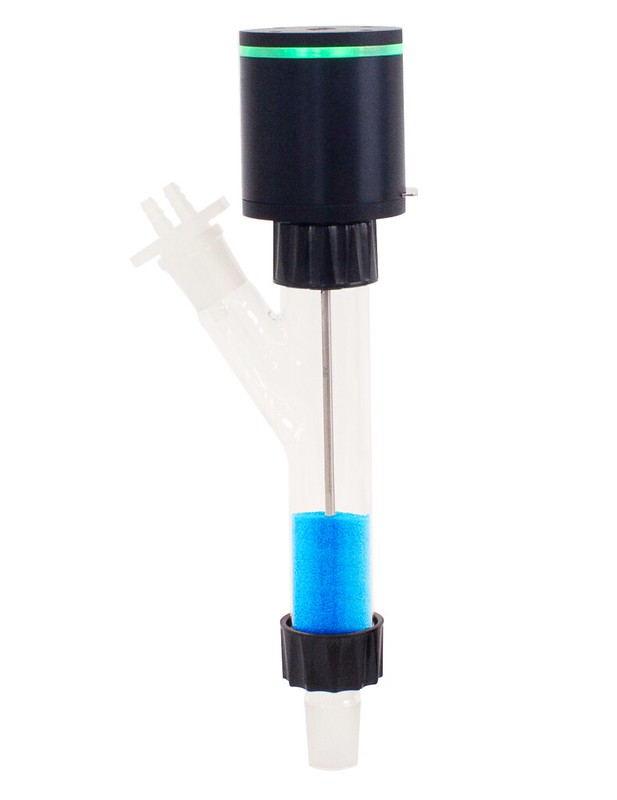
Volume: Approx. 0.2 l, 1, 3 l and 6 l glass vessel
Dimensions: Motor unit: Ø 8 cm × 12.5 cm (H), including flange | Control unit: 10.5 cm (H) × 9.47 cm (W) × 11.57 cm (D) | Glass vessel (0.2 L): 30 cm (H) × 12 cm (W) × 5 cm (D) | Glass vessel (1 L): 30 cm (H) × 18 cm (W) × 14 cm (D) | Glass vessel (3 L): 38 cm (H) × 21 cm (W) × 17.5 cm (D) | Glass vessel (6 L): 38 cm (H) × 21 cm (W) × 22.5 cm (D)
Range: From ~10 mg/min to 250 g/min (Based on NaCl under laboratory conditions)
Speed control range: 0-9999
Interface: USB 1.1/2.0 & REMOTE (CAN BUS)
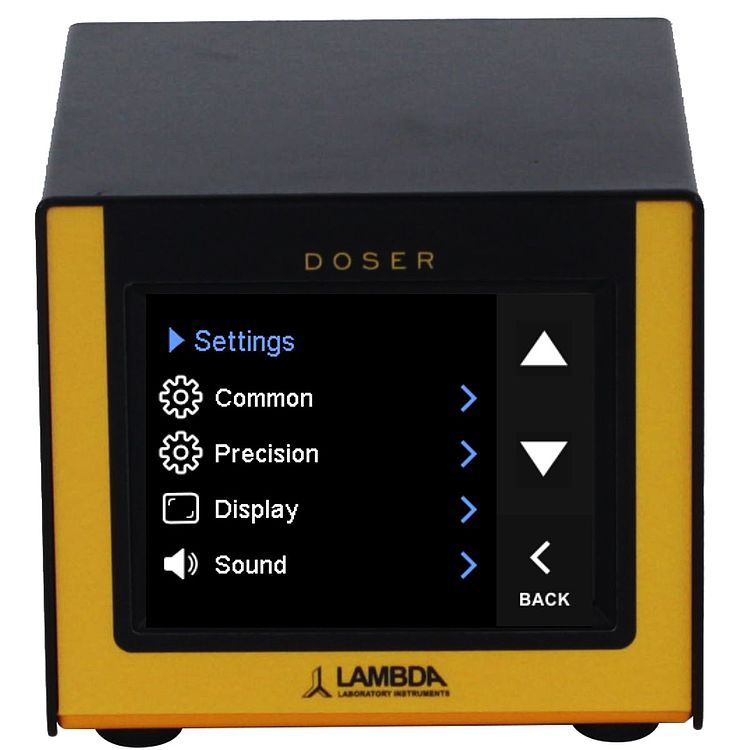
Display: 3.5” TFT IPS display with 320 x 240 pixels resolution; viewing angles ± 70°
Conformity: DIRECTIVE 2014/35/EU, DIRECTIVE 2014/30/EU
Technical Standards: EN 61000-6-1, EN 61000-6-4, EN 61010-1:2010/A1:2019/AC:2019-04,EN 61326-1:2013
Weight: 0.8 kg
Operation temperature : 0-40 ⁰C
Operation humidity: 0-90%, not condensing
Power supply: Plug-in power adapter 90–240V AC 50/60 Hz; 12V / 2.5A 30W barrel jack 5.5/2.1mm
Scientific Publications by Application Using LAMBDA Powder Dosing Systems
The publications below demonstrate the use of LAMBDA powder dosers, powder feeders, and Hi-DOSER systems across a wide range of laboratory, pilot-scale, and high-temperature process applications.
Pyrolysis, Gasification & Thermal Conversion
- Proust et al. (2024) – High-temperature pyrolysis of lignocellulosic biomass for biogas production.
Continuous biomass powder feeding using LAMBDA Hi-DOSER (1–20 g/min).
DOI / Publication - Wang et al. (2024) – Microwave co-pyrolysis of plastics and biomass.
Controlled solid feeding using LAMBDA DOSER 0.2 L.
https://doi.org/10.1016/j.cej.2024.150732 - Khan et al. (2024) – Particle feeding behavior during downdraft gasification of biomass waste.
Powder dosing with LAMBDA DOSER 0.2 L for gasifier studies.
https://doi.org/10.1016/j.envres.2024.118597 - Zhou et al. (2022) – Catalytic pyrolysis of waste plastics using structured catalysts.
Plastic pellet dosing with LAMBDA DOSER 1 L at controlled feed rates.
https://doi.org/10.1016/j.cej.2022.135836
Electrolysis, Metallurgy & High-Temperature Processes
- Luo et al. (2024) – Silica-supported metallocene catalyst preparation.
Solid addition using LAMBDA solid DOSER into reactor systems.
Patent publication - Singh et al. (2023) – Low-temperature aluminum electrolysis using inert anodes.
Continuous alumina powder feeding using LAMBDA DOSER.
https://doi.org/10.1149/1945-7111/ad0bae - Medino (2019) – Optimization of alumina feeding in aluminum electrolysis.
Stable alumina dosing (200–400 mg/min) using LAMBDA DOSER.
Thesis link
Catalysis, Chemical Reaction Engineering & Process Safety
- Ciércoles et al. (2024) – Sorption-enhanced methanol synthesis in fluidized beds.
Continuous sorbent addition using LAMBDA DOSER 3 L.
https://dx.doi.org/10.2139/ssrn.4735903 - Ran et al. (2022) – Safety criteria for semibatch solid–liquid reactors.
Controlled solid dosing of acids and bases using LAMBDA DOSER.
https://doi.org/10.1021/acsomega.2c02139 - Herrmannsdörfer & Klapötke (2021) – Semibatch crystallization of energetic materials.
Precision dosing of CL-20 and HMX using LAMBDA DOSER 0.2 L.
https://doi.org/10.1021/acs.cgd.0c01611
Energy Storage, Batteries & Nanomaterials
- Jie et al. (2023) – Plasma synthesis of graphene@Fe–Si nanoparticles for batteries.
Precursor powder feeding (1 g/min) using LAMBDA DOSER.
https://doi.org/10.1063/5.0159269 - Graves et al. (2020) – Continuous plasma synthesis of nanomaterials.
Gravity-fed powder dosing using LAMBDA DOSER.
https://doi.org/10.1039/C9NR08886E
Aerosols, Particles & Diagnostics
- Prüfert et al. (2022) – Inline aerosol analysis using LIBS and optical diagnostics.
Aerosol generation via LAMBDA DOSER 0.2 L.
https://doi.org/10.1016/j.sab.2022.106527 - Czech (2022) – Magnetic particle separation from fly ash.
Controlled powder dispersion using LAMBDA dosing system.
https://doi.org/10.3390/ma15020528
Biomass Processing & Biochemical Engineering
- Tai & Keshwani (2019) – Fed-batch enzymatic hydrolysis optimization.
Automated biomass feeding using programmed LAMBDA DOSER.
Publication link - Tai et al. (2016) – Fuzzy logic control of enzymatic hydrolysis.
Feedback-controlled solid dosing using LAMBDA DOSER.
https://doi.org/10.1007/s00449-016-1573-1
Publications by Powder Type Using LAMBDA Powder Dosing Systems
The following scientific publications demonstrate the successful dosing of various powders and solid materials using LAMBDA powder dosers, powder feeders, and Hi-DOSER systems.
Aluminum Oxide (Al₂O₃ / Alumina)
- Singh et al. (2023)
Continuous alumina feeding for low-temperature aluminum electrolysis using LAMBDA DOSER.
https://doi.org/10.1149/1945-7111/ad0bae - Medino (2019)
Alumina dosing (200–400 mg/min) for improved current efficiency in aluminum electrolysis using LAMBDA DOSER.
Thesis link
Biomass (Lignocellulosic Materials, Bagasse, Biomass Waste)
- Proust et al. (2024)
Biomass powder feeding (1–20 g/min) during high-temperature pyrolysis using LAMBDA Hi-DOSER.
Publication link - Khan et al. (2024)
Particle feeding of biomass waste in downdraft gasification using LAMBDA DOSER 0.2 L.
https://doi.org/10.1016/j.envres.2024.118597 - Krüsi (2014)
Dried and sieved bagasse feeding into a solar biomass gasifier using LAMBDA DOSER.
Thesis link
Plastics & Polymer Materials (PET, LDPE, Waste Plastics)
- Wang et al. (2024)
Powder feeding of plastic materials during microwave co-pyrolysis using LAMBDA DOSER 0.2 L.
https://doi.org/10.1016/j.cej.2024.150732 - Zhou et al. (2022)
Plastic pellet dosing for catalytic pyrolysis using LAMBDA DOSER 1 L.
https://doi.org/10.1016/j.cej.2022.135836
Ores & Metallurgical Powders
- Zarl et al. (2022)
Iron ore charging rate control in hydrogen plasma smelting reduction using LAMBDA powder doser.
https://doi.org/10.3390/ma15144767 - Ernst et al. (2022)
Continuous dosing of Carajás iron ore using LAMBDA powder dosing system.
https://doi.org/10.3390/ma15124065
Mineral Particles
- Gao et al. (2020)
Pulverized coal feeding (0.6–0.7 g/min) in a drop-tube furnace using LAMBDA DOSER.
https://doi.org/10.1016/j.fuel.2020.117078 - Czech (2022)
Fly ash particle dosing and dispersion for magnetic separation studies using LAMBDA dosing system.
https://doi.org/10.3390/ma15020528
Energetic Materials (CL-20, HMX)
- Herrmannsdörfer & Klapötke (2021)
Precision dosing of CL-20 and HMX during semibatch crystallization using LAMBDA DOSER 0.2 L.
https://doi.org/10.1021/acs.cgd.0c01611
Nanomaterials & Battery Precursors
- Jie et al. (2023)
Feeding of silicon and ferrocene precursor powders (1 g/min) for plasma synthesis of battery materials using LAMBDA DOSER.
https://doi.org/10.1063/5.0159269 - Graves et al. (2020)
Continuous powder feeding for plasma production of nanomaterials using LAMBDA DOSER.
https://doi.org/10.1039/C9NR08886E
Acids, Bases & Chemical Solids
- Ran et al. (2022)
Controlled dosing of solid acids and bases (citric acid, NaOH) in semibatch reactors using LAMBDA DOSER.
https://doi.org/10.1021/acsomega.2c02139
Powder Dosing System – Frequently Asked Questions (FAQs)
How fast can a powder doser be delivered after ordering?
LAMBDA powder dosing systems are available from stock and can typically be shipped within a few working days, depending on the destination.
What payment options are available for purchasing a powder doser?
Payment can be made by credit card via PayPal (no PayPal account required) or by bank transfer.
What particle size can a powder dosing system handle?
The powder doser can handle particles up to approximately 4 mm. Best dosing performance is achieved with homogeneous, free-flowing powders.
Can the powder doser handle powders that tend to clump or agglomerate?
Yes. Powders with poor flow properties may require conditioning. Improving flowability or purging the vessel with gas can help achieve more stable powder dosing.
Is the powder dosing system suitable for hygroscopic or oxygen-sensitive powders?
Yes. The powder feeder is airtight and supports inert gas purging (such as nitrogen or argon), making it suitable for moisture- or oxygen-sensitive materials.
Can abrasive powders be dosed safely?
Abrasive powders can be dosed. Wear parts such as glass vessels or distributors can be replaced if required.
How accurate is automated powder dosing?
The system uses quartz-controlled electronics for precise motor control. Final dosing accuracy depends strongly on the powder’s flow behavior and homogeneity.
Can a foot switch be used with the powder doser?
Yes. A foot switch can be connected to operate the doser as an ON/OFF control or to trigger a programmed dosing cycle.
Can the powder doser control mass flow rate (g/min)?
Yes. The powder dosing system allows programmable speed and time settings to control mass flow rates in grams per minute.
Is intermittent or portion-wise powder dosing possible?
Yes. The powder doser supports continuous feeding as well as intermittent dosing with programmable pauses or external control signals.
Are powder dosing vessels interchangeable?
Yes. Different glass vessel sizes, such as 0.2 L and 1 L, can be used with the same powder dosing control unit.
Are non-glass powder dosing vessels available?
The system uses borosilicate glass vessels. Optional silicone coatings are available to reduce breakage risk. Clear plastic vessels are not offered.
What is the difference between standard and fluid distributors?
Les distributeurs standard sont fournis par défaut. Les distributeurs de fluides sont conçus pour les poudres très fluides et fonctionnent généralement à des débits de dosage maximaux inférieurs.
Quels matériaux sont utilisés dans les composants en contact avec la poudre ?
Les pièces en contact avec la poudre comprennent du verre borosilicaté, du PTFE, de l'époxy et des plastiques techniques de haute qualité sélectionnés pour leur résistance chimique.
Quel est le rôle du bouchon de gazage ?
Le bouchon de purge permet de purger le récipient de dosage de poudre avec un gaz inerte ou sec afin de protéger les poudres sensibles et d'améliorer le comportement d'écoulement.
Comment la poudre est-elle transportée à l'intérieur du doseur de poudre ?
Un distributeur à spirale ouverte déplace délicatement la poudre vers la sortie, évitant ainsi le tassement et permettant une distribution de poudre lisse et homogène.
Quel type d'alimentation utilise le doseur de poudre ?
Le doseur de poudre fonctionne sur une alimentation basse tension de 12 V CC et peut également fonctionner sur une batterie de 12 V si nécessaire.
Le système de dosage de poudre est-il antidéflagrant ?
Le système fonctionne à basse tension en toute sécurité, mais n'est pas certifié antidéflagrant. Il peut être utilisé à l'intérieur d'un boîtier antidéflagrant disponible dans le commerce.
Le doseur de poudre peut-il être contrôlé par ordinateur ?
Oui. La commande à distance est possible via USB 1.1/2.0 et CAN BUS. Le contrôle par PC à l'aide d'un logiciel dédié est également possible.
Quelles températures les composants du doseur de poudre peuvent-ils supporter ?
Certains composants non électroniques peuvent tolérer des températures de stérilisation d'environ 120 à 130 °C .